The Cross Alone is Our Theology
A second message prepared and given on John 12:20-24 on September 13th, 2026.
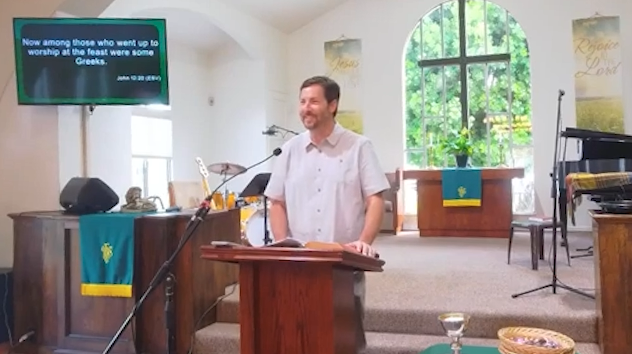
Click the image to watch the message.
Message given at Seaside Church in Torrance, CA on September 13th, 2026:
Brothers and sisters, I hope you've been well since the last hot day we spent together. It has been all hot days since then, it seems. Today I wanted to start with a quote that is attributed to Martin Luther from 1518. He said, when he was disputing with the Catholic Church back then and kind of beginning what we know as the Reformation, "The cross alone is our theology." And I think today, in this particular text, as these Greeks come to meet Jesus, we learn that essentially that's exactly what Jesus is talking about — that the cross alone is our theology. So while we attribute those words to Martin Luther, we ought to attribute that principle and precept, and effectively those words, to Jesus Christ, because he reveals himself here to these Greeks in the final week of his life as the Son of Man who was going to the cross.
So why don't we dive into the text? We'll go verse by verse, as we typically do, and I'll start by praying. Father, thank you for your Word, particularly your Word made flesh in Jesus Christ. Thank you for his welcome of these Greeks at this time, to just declare your will for his life, your will for our redemption, and by way of the cross, your manner of how our sin would be paid for. We thank you for Jesus's sacrifice, and we're so grateful that you brought us into right relationship with you through his sinless life and his substitution for us. And it's in Jesus's name I pray.
All right, well, let's start at verse 20. You know, it's kind of funny. Sometimes you get ideas or thoughts that kind of pop into your head. And I guess there was a Mediterranean festival at a church nearby in Torrance.
Okay, I see the heads are nodding, so it's kind of a popular thing. So that happened yesterday. And the draw is, of course, the food and the culture and everything. We're talking right now about this moment in Scripture as the festival of Passover happening, which, of course, is the great pilgrimage to Jerusalem that the Jews would observe to remember their deliverance from Egypt some — oh, gosh — I think 1,500 years-ish before Jesus was here in this moment. And so I think it's rumored that maybe a million or so, plus two million people, would come to Jerusalem during this time. So the capital that was already Jerusalem, which would normally have a good population, swelled in this week.
And yet the notoriety of Jesus had gotten out at this point in the Gospel to where even Greeks, as it's told to us, were coming to find out more about this guy from Nazareth. So let's look at verse 20: "Now among those who went up to worship at the feast were some Greeks." And now, like I said, this is the last week of Jesus. So we've spent, as Pastor Ben has taught, amongst others like me, through the Gospel of John — we've spent twelve chapters of the Gospel of John getting to this final week, and there are chapters 13 and onward, almost half, or perhaps even more, that are dedicated just to this last week and final days of Christ.
So that shows you how important the Passion Week, Holy Week, the road to the cross really is in the life of Jesus and how he fully ministered and gave his life for our sin. But you might think, okay, well now what's the "previously on," right? Where have we been in the last couple of weeks?
Well, we had at the beginning of chapter 12 Mary, the sister of Martha — what did she do? She took that very expensive jar of fragrance. She broke it, which was, you know, startling. And then she used her hair to anoint the feet of Jesus, which was kind of controversial and more startling. And how was that received by those around them at the time? "What a waste," right? That could have gone to much service for the poor. And what did Jesus say? "The poor you will always have with you, but I will not always be with you." And then moving on, we have the story of Lazarus, and at this point he's no longer dead.
He's living again, right? But even that was a catalyst for more conspiracy. Before this particular part of chapter 12, we realized that just Lazarus being alive again wasn't a miracle that the Jews could accept. It was something to develop another conspiracy around. If we can plot to get Lazarus pictured, then we can do the harm to the ministry and proclamation of Jesus that we intend to do and keep power. And the triumphal entry has happened. I didn't get to teach on that. I would love to have been here with you guys when that was taught. That's a great passage.
But it also plays two ways. It's how Jesus is received as king, but he's received as this earthly king. You know, the gathered worshipers are laying down the palm branches saying, "Hosanna, Hosanna! Blessed is he who comes in the name of the Lord, even the King of Israel," because that's exactly who they thought maybe Jesus was when he was riding into town — the King of Israel.
But Jesus is not just the King of Israel. He's not just in the line of David. He is the Son of God, Son of Man. So he is the King of kings. And so that kind of brings us up to where we are today, where Jesus's fame and his notoriety are colliding. And as much — let's look at how verse 19, before our text today starts — what did the Jews say when Jesus's notoriety and his fame collided? "Look, the world has gone after him."
Well, what does "the world" mean? We've talked about that before. I believe the word is cosmos. And it means the order of everything, the order of this world. So it includes us and how we go about one to another.
But that's how it leads right into verse 20, which said, "Now among those who went up to worship at the feast were some Greeks." Passover was for the Jews. But now the world has gone after him, Jesus. And that includes the world outside of Jerusalem, outside of Judea, outside of Samaria. It actually is now reaching the ends of the earth in some way in terms of Jesus's fame. And that includes these Greeks who have come to meet Jesus.
So again, verse 20: "Now among those who went up to worship at the feast were some Greeks." These Gentiles had caught on. You know, think of the Greeks. They were polytheists, right? They were very carnal. They were used to an empire that was in recession now because it was a Roman empire.
But they were a cultural influence as such. You know, there were Greeks that populated the area around Judea. Specifically, we have the Decapolis, which you guys might know or remember. It is the ten cities that were basically Greek outposts around the Sea of Galilee. And so that's probably where these Greeks come from, down from Galilee, drawn by the notoriety and fame of Jesus. And they want to meet the man. They're setting aside their polytheism, and they're not seeing circumcision as a barrier of entry into this King of Israel, which is really powerful because Jesus had said, "I have come to save the lost house of Israel."
And then Paul would later say, Jesus came to the Jew first and then the Gentiles. So now we start to see this message of the gospel through Jesus Christ not only playing out to the Jews, but also to the Greeks, as we say later in verse 21. So these came to Philip, who was from Bethsaida in Galilee, and asked him, "Sir, we wish to see Jesus."
Why Philip? Just, you know, it's like cast a lot — one of twelve, you'll get one guy who'll give you access. Well, that's not actually the case. Philip is a Greek name. We know it as an English name — Philip, Phil — you could probably make other derivations of that name. You know, we have Philippi, of course, that town which was later where the church was started by Paul.
But Philip is a Greek name meaning "lover of horses." So it's pretty interesting to know that you're known as a lover of horses, and yet somehow Jesus is still humble enough to ride the back of a donkey — you're at the great triumphal entry.
So that's one aspect of why the Greeks would pursue Philip. Did they know Philip? We don't know. But Philip being from Bethsaida — again, this is northern Galilee, and where the Decapolis was, these Greek cities, these Greek towns — there's just a way, like L.A., where certain neighborhoods kind of rub up against each other and we get to be neighbors, even though we have different cultures. Judea was a more multicultural place than we could give it credit for, even as much as the Jews would like to have it be their own, and they'd like to have the Messiah come and liberate them the way Israel, the state of Israel, is today.
Because the map hasn't changed. It's really like this thoroughfare of culture between Africa, Europe, and Asia. And so right in the middle, certainly with God's intention, is the land of Israel, the chosen land where Jesus would come into Jerusalem. So by Bethsaida being in northern Galilee, this is another clue as to why Philip was the sort of point of access for these Greeks. "We want to meet Jesus. How can we meet Jesus?" And then he goes and tells Andrew. Andrew as well is from Bethsaida. So here you have kind of ministry at scale. And what did Jesus do when he sent his apostles out?
Teams of two, right? So it makes perfect sense now that some of this sort of teamwork and ministry — maybe it's becoming the culture of how the gospel goes. When you go talk to one, you talk to another. And I think there's actually — not only is this kind of like a chain of command we could see: okay, they come talk to Philip, now let's go talk to Andrew.
Let's figure this out. And then we get to Jesus. It's like a chain of command was also a chain of partnership. And I think there's a little bit of a point of application here, as you guys do church at Seaside. You have teammates all around you, right? When we have faith in Christ, we should have a shared identity. And so it's not on just your shoulders. To get stuff done involves someone in the work. Because clearly here that's what Philip was doing, I think in a godly way — involving Andrew to say, "Hey, these guys want to meet Jesus. What should we do?" And what do they do?
They go to Jesus, because then Jesus tells us what to do, because he's Jesus. So I think that's an interesting point of application: that as these sort of outsiders, as these non-Jews want to meet the man, the door's open — but the door's open because we have a heart of service.
Okay, well, let's go to verse 23. And Jesus answered them — so he's answering Philip, Andrew, and the Greeks — "The hour has come for the Son of Man to be glorified." And as I said, with the world going after Jesus, evidenced by the Greeks now making this Passover pilgrimage, Jesus is stating this publicly. He's talking about this hour.
Let's deal with the word "glorified" first. What does glorified mean when it hits your ears? Honor being bestowed, a medal being awarded, having your name in lights. And that's kind of the glory. It's funny — another thing that came to mind. I got to go to the USC game last night with my son and my brother-in-law and his dad. They're the ones with tickets. And so when you're invited to games like that, you go, because then you don't have to be the season ticket holder, right? And then interesting things happen. At USC, since I went there twenty-odd years ago for grad school, everybody's name is on something.
They have found a way to monetize almost every square corner of everything, including the Coliseum, which they only have a lease on. And yet everybody's name is on something. That is earthly glorification. And yes, you can exchange a contribution and receive this tunnel being named after you, or the scoreboard being named after you, or having your brick — even that is probably more my budget. I could do that in front of the Coliseum now and have that be named for me. And that's earthly glorification.
But the Son of Man is to be glorified, and the Son of Man is a title that Jesus has used for himself. So he's not talking about earthly glorification. He's mentioned this name of himself earlier on, as early as, I think, the fifty-first verse of John 1, but it refers to something Daniel said in his prophecy. So let me read from Daniel 7:13–14: "And behold, with the clouds of heaven there came one like a son of man, and he came to the Ancient of Days and was presented before him. And to him was given dominion and glory and a kingdom, that all peoples, nations, and languages should serve him.
"His dominion is an everlasting dominion, which shall not pass away, and his kingdom one that shall not be destroyed." So Jesus is now declaring in verse 23, the hour — this time, this moment — has come for the Son of Man to be glorified, and this glory is going to come according to the prophecy of Daniel.
But it's not always as we've seen when we think of our things in our earthly lens. You know, we might think of glorification as "let's cash the check, let's ride the wave, let's live the dream" — my wife and I. And it's funny because the triumphal entry involves the donkey. We were just, you know, having a fun conversation speaking about maybe our sort of earthly glorification will be when the kids are launched. We'll have — we have hound dogs right now. So we have obnoxious pets, and we want a donkey because a donkey is another obnoxious pet. And so in some ways, ours is going to come from maybe a brick at the Coliseum and maybe another obnoxious pet like a donkey.
But again, "glorified" means something to God that we couldn't understand until the grace of God gave us Jesus Christ and the cross. How does Jesus explain this? Because again, the Greeks needed to know it. We need to know it today.
Verse 24: "Truly, truly, I say to you" — this is Jesus speaking — "unless a grain of wheat falls into the earth and dies, it remains alone; but if it dies, it bears much fruit." If not for the sinless Jesus Christ and his willing, selfless death on the cross, sacrifice would just be kind of a trope. It'd be a narrative arc. It would be a device in a story. You guys have indulged in the past talking about movie quotes for a while.
Let's do three from Disney. We have Disney fans in here. Oh yeah. Disney has made a big company out of this kind of trope. Okay, the movie Up, which is Pixar. The first few minutes of the movie involve a love story between a husband and wife, and then the wife dies, like in the first five minutes. Sorry. Spoiler alert, right. Sorry, Bambi. We probably all know Bambi, right? Beautiful little deer — within the first act, mom is lost in a fire. Lion King — circle of life. If not for the king to be caught up in that stampede and die, we wouldn't have the forging of King Simba.
But these are all Disney's take on the triumph of the will. What Jesus is talking about here, when the Son of Man is to be glorified, is a triumph of God's will. And so that's why what he's talking about isn't just a trope. There's a selflessness. There's a sacrificial nature of Jesus going to the cross. There is this proclamation to these Greeks that even for them, outside of the chosen people, this sacrifice has substance, because the power of sin, as we'll see later in the text, is going to be dealt with. And that's what he means when he talks about in this sort of parable of this wheat, the grain of wheat here.
It propagates new life when it dies and falls into the earth. I mean, the first time I got to teach with you guys last year was the parable of the soils, right? And we know in the good soil the seed has a harvest that's thirty- or sixtyfold or a hundredfold. It's about a bumper crop that is the ministry of the church.
But two thousand years later, we have a bumper crop of believers who are called to go make more believers. Let's look at — yeah, let me do verse 24 one more time: "Truly, truly, I say to you, unless a grain of wheat falls into the earth and dies, it remains alone; but if it dies, it bears much fruit." You might have heard the saying that Tertullian wrote: the seed of the church is the blood of the martyrs. And yet Jesus has called himself the cornerstone. And in Matthew 21:42 it was written, "The stone that the builders rejected has become the cornerstone. This was the Lord's doing, and it is marvelous in our eyes."
So we ought to remember that when the Son of Man is to be glorified, this is a marvel to our eyes, because it's not something we could do for ourselves. And this actually — when Jesus said this, he's quoting Psalm 118, and the verse that comes right after that quote in Psalm 118 is a verse that probably all of us know by heart: "This is the day that the Lord has made; let us rejoice and be glad in it." So we can certainly rejoice in this day right now, as the Lord has made it, because the weather is finally temperate and we are all here together, and we have this wonderful shelter, and we have the Holy Spirit present among us, and we are celebrating Jesus, and we're going to do communion.
But because of Christ on the cross — the cross alone being our theology — that's why we actually get to rejoice, because we get to do that for eternity in heaven. And this is God's plan. Verse 25: "Whoever loses his life loses it" — I'm sorry, excuse me — "Whoever loves his life loses it, and whoever hates his life in this world will keep it for eternal life." This is very strange logic for us who want to build bigger storehouses, or who want to wear our Sunday best, or who want to put a presentation to the world that we have it all together. Whoever loves his life loses it — well, that just means when it's over, it's over.
There was a play in high school that I did stage crew for called You Can't Take It With You. It was a comedy, right? Because you can't. You can't take it with you. What you have here, you can't take it with you.
But what you have in here, you can. This little light of mine. And John, the writer of this Gospel — he kind of hammers this point home. I love when the Bible gives its own interpretation and application and argument in one bit.
But when we're talking about how you don't want to love what you have here in the world so much that it will distract you from God's will for your life, let's look at what 1 John 2:15–17 tells us: "Do not love the world or the things in the world. If anyone loves the world, the love of the Father is not in him. For all that is in the world — the desires of the flesh and the desires of the eyes and pride of life — is not from the Father but is from the world. And the world is passing away along with its desires.
"But whoever does the will of God abides forever." Now the apostle John wrote this decades after this moment in the Gospel, but I'd love to think that he had the presence to know of following Jesus being so important as to tell the Greeks, in a little sidebar in this moment: hey, you guys love your many gods, but they're demigods and they push power down. We have — deity added — I'm sorry — humanity added to deity in the person of Jesus. He came down from heaven to serve us. It's a whole flip of the world's outlook, just as it is today.
So Jesus gives explanation in verse 26: "If anyone serves me, he must follow me; and where I am, there will my servant be also. If anyone serves me, the Father will honor him." I've mentioned in the past that my favorite Dietrich Bonhoeffer quote is "Only he who believes is obedient, and only he who is obedient believes," right? The following of Jesus is a command to be obedient.
But then Jesus says, my commands are not burdensome. It's just love God with all your heart, soul, mind, and strength, and love your neighbor as yourself. And in the doing of that we realize, oh, we can't do that without the grace of God which is given to us, and we don't do it under our own strength. We do it by his strength because he has done what he's about to do.
Let's go to the cross for our sin. So here we are in verse 27: "Now is my soul troubled. And what shall I say? 'Father, save me from this hour'? But for this purpose I have come to this hour." And I think again, we're in this audience of the Greeks amongst the disciples. Jesus is carrying a burden to the cross, yet he goes willingly. He's more than a martyr. The martyr is the seed of the church.
But Jesus is the cornerstone of the church. Is he going out of fear? No. Jesus wasn't afraid to go to the cross. Is he going out of doubt or denial, or any of the things that would happen amongst the disciples in the next coming chapters? No, his soul is troubled because the weight of sin is that great. Our condition in sin is that much of a separation from our God, whose image we bear and where he is in heaven, and how far away that is, and how hard it is to get there, and how impossible it is to get there under our own devices. Jesus knows the full weight of the sin, which should tell us as believers what he was carrying that troubled his soul.
It was a heavy weight to bear — more than we can qualify, more than we can calculate. Yet he went willingly. I kind of think that Jesus in his mind, because he was so good — the author of Scripture — that he could quote Scripture whenever he needed to as God was revealing himself through Jesus to us.
Let's think of Psalm 23:4: "Even though I walk through the valley of the shadow of death, I will fear no evil, for you are with me; your rod and your staff, they comfort me." Jesus tells the Greeks, he tells the disciples: "But for this purpose I have come to this hour." So in verse 28 of our text today: "Father, glorify your name." Jesus is saying here, not my will be done, but your will be done. And he taught us this when he told the disciples how they should pray. And we get to say that — we'll say it again today — but let's read it now.
The wonderful Lord's Prayer. Jesus in Matthew 6 said, "Pray then like this: Our Father in heaven, hallowed be your name. Your kingdom come, your will be done, on earth as it is in heaven. Give us this day our daily bread, and forgive us our debts, as we also have forgiven our debtors. And lead us not into temptation, but deliver us from evil. For if you forgive others their trespasses, your heavenly Father will also forgive you.
"But if you do not forgive others their trespasses, neither will your Father forgive your trespasses." That's a pretty difficult task if we think about it in our own mind and effort. Forgiveness is hard to do, but Jesus will later say at the cross — several chapters from now, but only days from now in time — "Father, forgive them, for they know not what they do." So when we look to the model of forgiveness, we look to the soul that bears trouble, that still goes to the cross and forgives as he is the substitute for our sin, and becomes that exchange of righteousness that we then get by.
Nothing we can do, but all that we receive. And in this way we can take heart that forgiveness comes when we know that we have forgiven. First: "Father, forgive them, for they know not what they do." And so verse 28, picking up verse 28 in our text today: then a voice came from heaven — "I have glorified it" — this is the name — "and I will glorify it again." So there are a couple of times in the Gospel of John where the voice from heaven cries out, and it's the Father talking. And for those who have ears to hear, let them hear. For those who have eyes to see and read this text, it's our Father in heaven voicing out his affirmation of his Son on earth.
We have that in Matthew 3:17: "This is my beloved Son, with whom I am well pleased." That was when Jesus was baptized. We have it again at the Transfiguration, Matthew 17: "And behold, there appeared to them Moses and Elijah, talking with them. And Peter said to Jesus, 'Lord, it is good that we are here. If you wish, I will make three tents here, one for you and one for Moses and one for Elijah.' He was still speaking when, behold, a bright cloud overshadowed them, and a voice from the cloud said, 'This is my beloved Son, with whom I am well pleased; listen to him.'" Here again this voice from heaven is saying, "I have glorified it."
Those are two instances — and "I will glorify it again" at the cross, because the cross alone is our theology. There's a little standard. So I've been in video production in business for almost thirty years now, and I've gotten to the point where you've got to be efficient, so you write your own contracts. Obviously, I do research for contracts. There's this term called "avoidance of doubt." For avoidance of doubt: you know, client agrees to and vendor agrees to, blah, blah, blah. I think this is kind of the Father in heaven being so gracious to us by his Word and saying, "I have glorified it" — the name of my Son — "and I will glorify it again."
For avoidance of doubt, I am sending my Son, who is going willingly to the cross for my image-bearers so that we can be redeemed. But the crowd — this is a great crowd — and in verse 29 they say: the crowd that stood there heard it. So they heard the voice and said that it had thundered. Well, we heard some thunder, I think last week with the storms that came through, and the first crack of thunder never sounds like a word to me. Although it is God ringing out in creation, it sounds like something I want to be sheltered from. So I can understand the reception of the Greeks — the awe and fear of this voice — and also understand that there was a point in time where I couldn't discern the Word of God.
You know, I hadn't been drawn in yet by the Father, but by his grace he did. And so that's what they're hearing. Others said an angel has spoken to him. But the Gospel writer tells us that this is the Father speaking from heaven. And how do we know? Jesus tells us in verse 30. Jesus answered, "This voice has come for your sake, not mine."
Now why would you say that? Because everything the Father has done, including sending his Son from heaven, having him stoop to our condition in humanity, having him approach the cross, having him go through all that he's about to go through the next several days — it's for our sake. It's so that we may be in relationship with the Father in heaven. Jesus knows this. He knows all these facts. He knows all the story. He knows the arc. He knows that he's not a plot device in a Disney movie. In fact, he continues, verse 31: "Now is the judgment of this world.
"Now will the ruler of this world be cast out." At long last, in a couple of days' time, the head of the serpent will be crushed. Jesus on the cross will say, "It is finished." What is he describing when it is finished? The power of sin no longer holds power over us. Jesus's righteousness on the cross and the exchange of his life and his taking all of our sin upon him in death — the ruler of this world, the prince of the power of the air, as we talked about in Ephesians 6, the devil — he will be cast out. He will no longer have, for those who believe in Jesus, power over us to deceive us. We will still live in our flesh.
We'll be in the presence of sin in this world that we're told is passing away. But Jesus is saying the quiet part out loud: now is the judgment of this world; now will the ruler be cast out. And verse 32: "And I, when I am lifted up from the earth, will draw all people to myself." And so we're approaching the end of our text today, and this is one of the most fascinating revelations that Jesus does, looking back to the whole story of God's revelation to his people. So "lifted up" — we could probably discern "lifted up" means he's going to go up on the cross, right? Like I've been hammering home: the cross alone is our theology.
As archaeology, we know what crucifixion is — represented right there behind me, and our icon of how the Romans devised this incredibly excruciating way to terminate life. But back in Numbers 21:4–9, the Israelites were rebellious against God's deliverance plan for them. They wanted to go back. They wanted to complain. They wanted to curse God for the situation they found themselves in. And so God commanded fiery serpents to torment the people. And they were biting, and they were snapping, and they were causing physical harm. And then he commanded Moses to fashion a bronze serpent and put it on a pole. And when that was lifted up, and their eyes looked upon that pole, they would be healed.
So there you have this Christ-type, this image of God's grace and salvation for the Jews, being echoed by Jesus saying, when I am lifted up — the cross wasn't an accident. It wasn't just, well, the best means of torture and death available at this particular time. It was significant all the way through how God had been working with his people in his plan to redeem them all along. And I think that's fascinating to look back, especially as in John 3:16, which we all know: "For God so loved the world, that he gave his only Son, that whoever believes in him should not perish but have eternal life." Right before that, in John 3:14–15 it reads: "And as Moses lifted up the serpent in the wilderness, so must the Son of Man be lifted up, that whoever believes in him may have eternal life."
So it all comes back together. This glory of being lifted up on the cross is essentially the theology that goes back into the Old Testament. So verse 33: he said this to show by what kind of death he was going to die. Yeah — the cross. Before that he'd be betrayed, denied, abandoned, tried, beaten, scourged, made to be his own mover, carry his own cross until they got a little bit of help. And then he'd be stripped and he'd be pierced and be lifted up. And that's troubling to the soul, we think.
But that's not what troubled Jesus's soul. Remember, the troubled soul was: there is so much sin to be paid for. And yet I'm willing. What a good, wonderful Savior. So to conclude our text today, verse 34. So the crowd answered him again — the crowd, the Greeks. The Greeks had come wanting to meet Jesus. They wanted to get an autograph.
Well, let's say they wanted more than an autograph if they wanted to meet him. They say, "We have heard from the Law that the Christ remains forever. How can you say that the Son of Man must be lifted up? Who is this Son of Man?" That Jesus is — and it wasn't in our text today, but Jesus speaks in parable right away. So this will be our final application point, because I think we can take this verse with us as we go.
Well, maybe I'll repeat it again in the benediction, but verse 35 continues. So Jesus said to them, "The light is among you for a little while longer. Walk while you have the light, lest darkness overtake you. The one who walks in the darkness does not know where he is going. While you have the light, believe in the light, that you may become sons of light." So the Son of Man is the Son of God. And while we have breath in our lungs, we can understand who the light of men was. It was Jesus Christ. And for these Greeks — Tuesday of Passion Week, maybe Wednesday; I'm not really sure what the exact day was — but only days from the cross, days from when the whole price would be paid.
On the cross. We end up with Jesus revealing himself as the Son of Man, saying to them: put aside your distractions of polytheism. While you have the light, believe in the light, that you may become sons of light.
Meant to Proclaim
A second message prepared and given on John 11:1-27 on August 16th, 2026.
Here is a message given at the second service, “Parousia,” on August 16th ,2026 at Seaside Church in Torrance. It covers the experience of Martha as Jesus returns having received word of Lazarus’ dire illness, as covered in John 11:1-27. Click the image to enjoy the video.
What does Messiah mean to you?
A second message prepared and given on John 10:22-42 at Seaside Community Church in Torrance on August 9th, 2026.
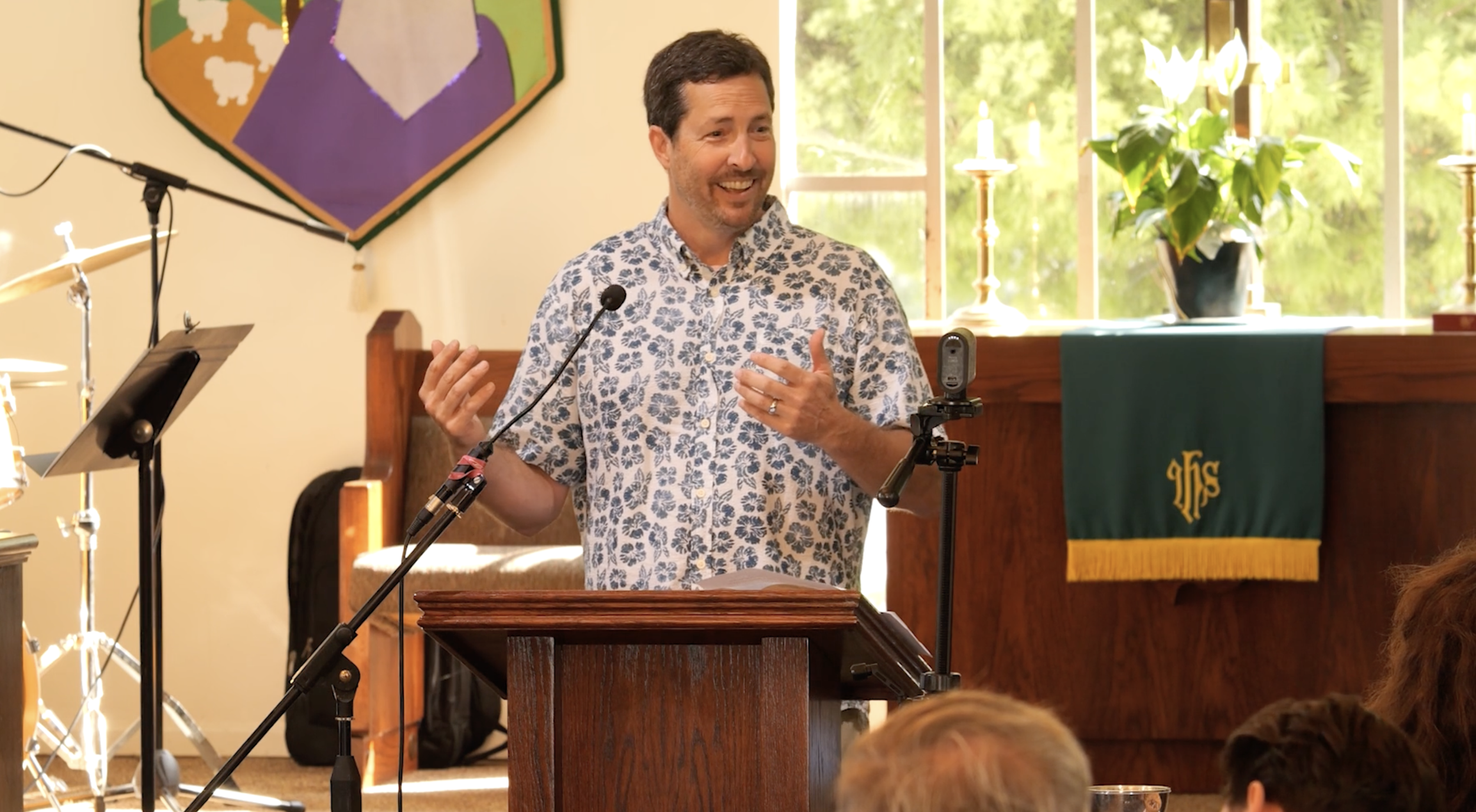
With a second service recently added, this is a message given August 9th, also on John 10:22-42 that goes into more depth and interprets from a different perspective than the first service. Click the image for a link to the video.
The Controversy of Christ
A message given on John 10:22-42 at Seaside Community Church in Torrance on August 9th, 2026.
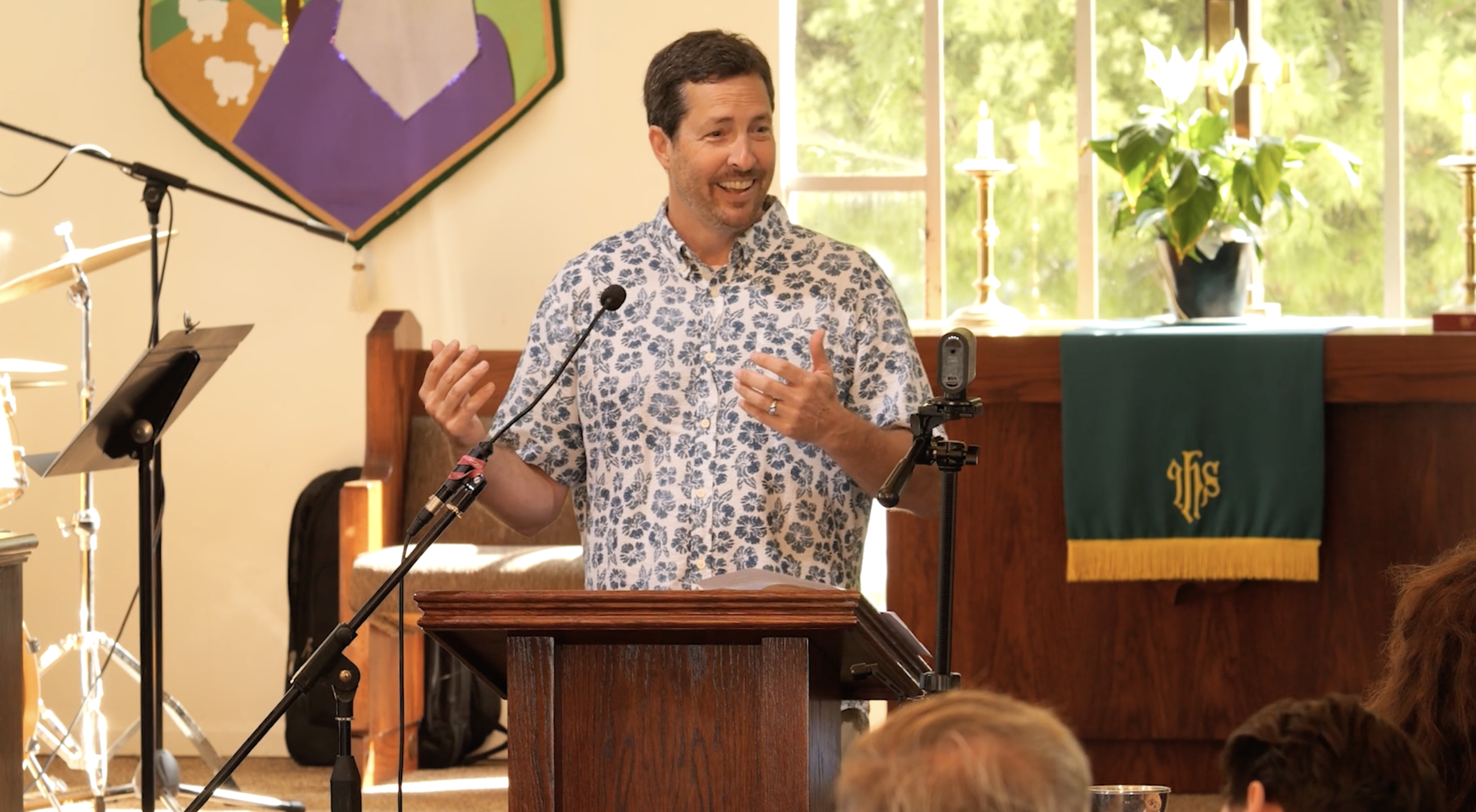
Another opportunity to preach at Seaside Community Church in Torrance during their pastor’s sabbatical, how nice to be with my brothers and sisters on August 9th, 2026 with a message on John 10:22-42. Click the image for a link to the video.
I Am the Light of the World
A message given on John 8:12-30 at Seaside Community Church in Torrance on July 5th, 2026.
Another opportunity to preach at Seaside Community Church in Torrance during their pastor’s sabbatical, how nice to be with my brothers and sisters on July 5th, 2026 with a message on John 8:12-30. Click the image for a link to the video.
The Woman Caught in Adultery
A message given on John 7:53 - 8:11 to Seaside Church on June 28th, 2026.
With Pastor Ben on sabbatical, I enjoyed the opportunity to bring this message on June 28th, 2026 at Seaside Church in Torrance. Click on the image above for the sermon video!

1 Corinthians 2:1-13 Infants In Christ
A message prepared for the Young Adults ministry at Calvary Chapel Palos Verdes on November 13th, 2025.

This message was given to the Young Adults ministry at Calvary Chapel Palos Verdes on November 13th, 2025. Click the image above to give it a listen.
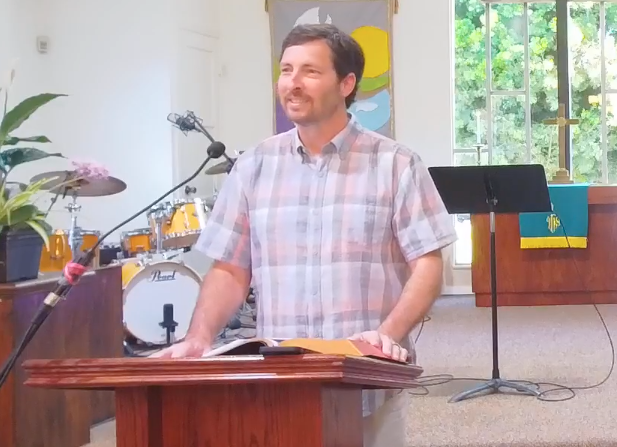
The Whole Armor of God
A message given on Ephesians 6:10-17 to Seaside UCC on January 18th, 2026.
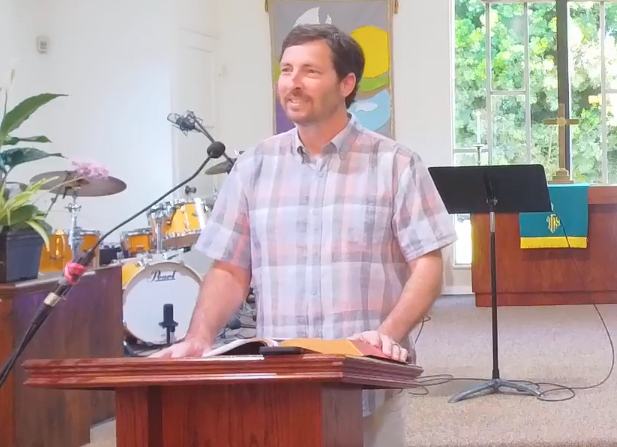
I received an invitation to guest preach once more at Seaside UCC in Torrance on January 18th, 2026, serving as a fill-in for Pastor Ben. It was a joy to bring them an expository message through Ephesians 6:10-17. Click on the image above for the sermon video!

Who are you? 1 John 5:1-5
This message was prepared from 1 John 5:1-5 and given to the Young Adults ministry at Calvary Chapel Palos Verdes in November 2025.

This message was given at Calvary Chapel Palos Verdes Young Adults ministry on September 11, 2025. Who are you? God really wants to know. Click the image above to listen to the message.
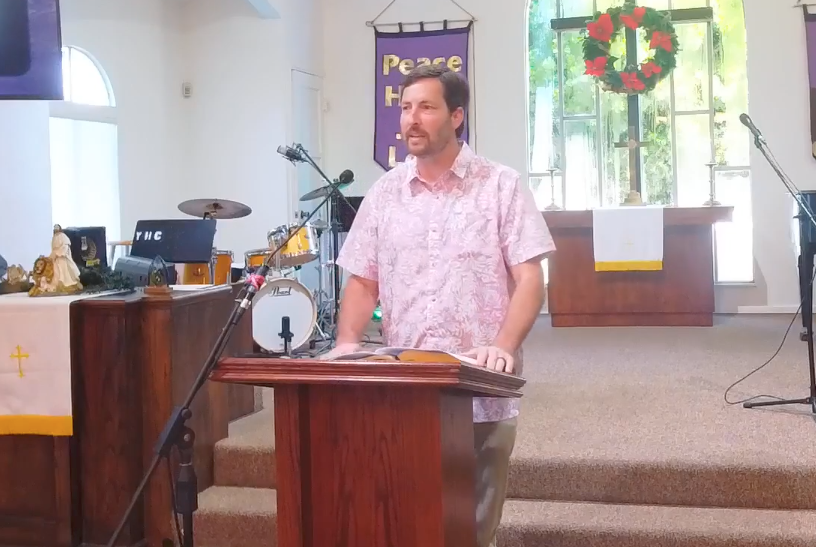
Parable of the Sower
A sermon entitled “How’s Your Hearing?” on Matthew 13:1-9, the Parable of the Sower.
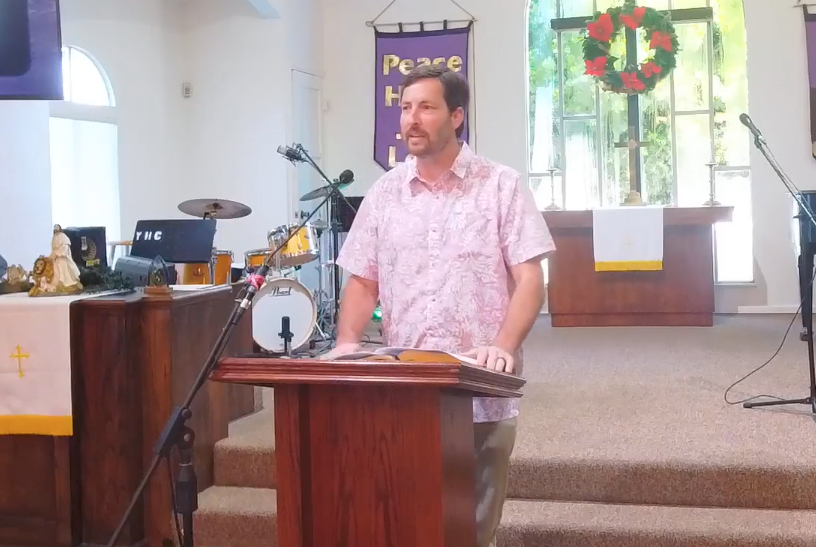
In late 2025 I was sent out on behalf of our church (Calvary Chapel Palos Verdes) to provide guest preaching to a local area congregation (Seaside UCC, Torrance, CA) as fill in for their sole pastor. In particular, their request was to provide expository preaching to the body. Click the image above to enjoy the message from Matthew 13:1-9.

Me, My, Mine?
To be an individual in community is like a branch on a vine.
I hear a lot of proclamations within Christianity of, “I want to make my faith my own.” Honestly, I do recoil a little when I hear this, though I trust in the Lord that He sanctifies as He saves. However this proclamation does imply an individuality that can be a distraction from the community inherent in knowing by faith we join an assembly that is the body of Christ.
As Dr. Stephen D. Lowe and Dr. Mary E. Lowe together write in chapter nine of Ecologies of Faith in a Digital Age, “the syn connection we have with Christ supplies all of the spiritual nutrients needed for proper growth, and indeed, gives life that marks possible our growth.”[1] This immediately calls to mind John 15:5, “I am the vine; you are the branches. Whoever abides in me and I in him, he it is that bears much fruit, for apart from me you can do nothing.” (English Standard Version)
This verse asserts that we are related and relatable to Christ, but separate and dependent upon his holiness to bear fruit. As well, in the reference, a vine is never constituted by one branch. That would not make for much fruit nor wine. Rather community is represented by Christ asserting that he is the body and by definition a healthy vine consists of a plural of branches. As we are individual believers, we are but one branch thus we cannot vainly attribute to ourselves greater significance within this ecological motif than a contributory, dependent piece.
Relatedly, the apostle Paul builds upon this example in Romans 11 when addressing gentiles as branches grafted into the community of faith. “And you, although a wild olive shoot, were grafted in among the others and now share in the nourishing root of the olive tree, do not be arrogant toward the branches. If you are, remember it is not you who support the root, but the root that supports you.” (Rom. 11:17-18)
Paul’s counsel to remember where our support comes from, that is Christ where our hope comes from, is helpful as well that it tells us not to be arrogant. As Paul was making this overture in a disembodied medium of the letter, certainly it applies today to how we should understand grafting and humility in a disembodied context that still promotes community over the individual. We are meant to grow in Christ among other believers, and we are shown that community can be encouraged, exhorted, and promoted through a disembodied context. Even in a digital context today, it is not isolation that fosters growth, but acknowledgement of the example of a branch within a vine, truly the shared identity in Christ, that unifies us rather than separates us.
[1] Stephen D. Lowe Ph.D and Mary E. Lowe Ph.D., Ecologies of Faith in a Digital Age (Downers Grove, Illinois: IVP Academic, 2018), 148.

Cut From the Same Cloth
Sowed first, cut later.
When passing on a compliment of you having inherited some gifts, or that you’re displaying a generational merit, people will often say you’re “from good stock” or “cut from the same cloth.” We don’t know what the future holds, but most cultures are reasonably focused upon determining where they’re from. So too, and how true, for the Jews. They are God’s chosen people, the Israelites, and their story traces back before King David, before Moses, and before even their selection by God of the man Abram. Their origin story points to the creation of the first man and woman in the Garden of Eden and the direct relationship with God that entailed.
This is important to remember for Christians today. Though God foreknew his elect (Rom. 8:29, English Standard Version), Christians are being “born again” by grace through faith all over the world all the time by the rebirth that happens in baptism according to the Great Commission (Matt. 26). As it turns out, baptism and faith conjoined us into the same cloth we were all originally cut from, as the earliest Christians who were largely Jesus-believing Jews. As Elwell & Yarbrough write, “The early Christians saw themselves as the people of God and the inheritors of the Old Testament promises.”1 Dr. Robert Wayne Stacy concurs by saying, “Christianity began as a legitimate movement within the piety of first century Judaism.”2
This is significant for Luke as the author of Acts, and himself a gentile. The gospel he wrote chronicles the ministry, death, and resurrection of Jesus through careful interview of the Jewish players (disciples et al); the book of the Acts of the Apostles introduces the power of the promised Holy Spirit working through the birthed church that grows to fulfill the Great Commission. Acts is still very much a contemporary model for us present-day believers, exemplifying the good stock we come from. We were made for good works, and Acts is the book to showcase them, from Peter’s bold preaching at Pentecost (Acts 2:1-41), to a life lived in service & community among believers (Acts 2:42-47), to drastic conversions of the likes of Saul of Tarsus into Paul the missionary (Acts 9), Luke is writing about what Jews do when they take following Jesus seriously.
What we Christians today must remember is that our God – the Triune God of Father, Son, and Holy Spirit – has been and remains at work (John 5:17) as we are invited into the right relationship with him through faith in Jesus Christ. At church this past Sunday (Calvary Chapel Palos Verdes, CA) by providence we are two weeks into proceeding through Acts verse-by-verse. God is certainly good in His timing to put this blog post into the midst of a fresh sermon series. One of Pastor Daniel’s key points was that he believed Pentecost, in its sound of wind (Acts 2:2), tongues like fire (Acts 2:3), and all manner of languages heard AND understood (Acts 2:5-11), that it represented the inverse of the tower of Babel calamity (Gen. 11:1-9). Here, by the power of the Holy Spirit, unity and purpose were given to man as opposed to taken from them in their aspirations to raise themselves to the height of God. Since their languages were separated from the tower of Babel episode, at last, that distinction was made invalid for the sake of unity in birthing the church. It was a point I hadn’t considered before, but it represents the heritage the early church had, that we still have, to the way God interacted with his people in earliest history.
Luke took pains to demonstrate the early church as authentically Jewish because the story of God and his people traces back through the Jews to the authorship of man altogether for the sake of salvation by one God-man altogether, Jesus Christ.3 Some examples include:
The Jewish feast of Pentecost (Shavuot) was primarily a thanksgiving for the firstfruits of the wheat harvest, but it was later associated with a remembrance of the Law given by God to Moses on Mount Sinai. (Acts 2)
Peter’s sermon begins with detailed recitation of Scripture, the first time we actually have recorded his use of citing Scripture, when he quotes the prophet Joel. (Acts 2:17-21)
Peter refers to the “patriarch David” as an example of a Jewish protagonist who prophesied about Jesus, quoting, “The Lord said to my Lord, Sit at my right hand, until I make your enemies your footstool.” (Acts 2:29, 34-35)
Without these and other exacting bridges authored by Luke, inspired by the Holy Spirit, meant to combine the nascent church with the historic faith, our faith lineage would resemble the arbitrary incompleteness of alternate world religions.
1Walter A. Elwell and Robert W. Yarbrough, Encountering the New Testament: A Historical and Theological Survey
Links to an external site., Third Edition., Encountering Biblical Studies (Grand Rapids, MI: Baker Academic, 2013), 188.
2Robert Wayne Stacy, Ph.D. The Jewish Setting of the Early Church In Acts. Liberty University, 2019. https://canvas.liberty.edu/courses/628598/pages/watch-the-jewish-setting-of-the-early-church-in-acts?module_item_id=70858838
3Robert Wayne Stacy, Ph.D. Pentecost and the Eschatological Setting of the Early Church In Acts. Liberty University, 2024. https://canvas.liberty.edu/courses/628598/pages/watch-pentecost-and-the-eschatological-setting-of-the-early-church-in-acts?module_item_id=70858851

Recognizing Truthful Old Testament Themes
History started with truth and endures by truth.
The first eleven chapters of the book of Genesis cover creation through the Tower of Babel. What God accomplishes during these chapters is to create everything out of nothing, set this creation into order & time, affirm it, and delegate authority of stewarding creation to the part of his beloved made in God’s image, namely man (Genesis 1:1-27, English Standard Version).
Various theological themes about God are presented in this portion of Genesis. First, as Hamilton notes in Handbook on the Pentateuch, God is represented in oneness.[1] As we read the outset of Scripture, we are introduced to one God, as opposed to an ensemble of deities commonly known from polytheistic traditions. Often in polytheistic traditions, the many gods are assigned a specialty or representation, but the God of the Bible is the creator God and creation flows from His will and speech. According to Hamilton, “It is God’s oneness that alone makes sense of words such as “universe” or “universality.”[2]
A contemporary theme in popular entertainment cites the prospect of a multiverse, as if there are parallel universes running in time and in stride beyond our immediate perception. Being an experienced filmmaker myself for several decades, it has become a bit laughable to see the narrative calisthenics that screenwriters and directors will resort to in hopes of reconciling this dimensional hypothesis into a cogent story. I liken this trend to deistic-naval-gazing.
After all, who sets a multiverse in order? It can’t be simply down to when a movie starts it by default assigns the first scene must the primary dimension. Rather, God is one, and He has set about His truth as revealed in the outset of Scripture. Without His oneness to exist outside of time, how might we even establish which of the innumerable multiverses is actually the primary one? Instead of imagining what other versions of ourselves or our heroes would do in fictional alternate realities, we ought to remember His creation of the universe has sufficient endemic complexities worthy of a lifetime’s study and glorification.
One other interesting point I find with the creation story is its brevity in description. “In the beginning, God created the heavens and the earth.” (Gen. 1:1) The vastness of the heavens and earth certainly exceeds the sum of ten words, but it’s the matter-of-fact succinctness which compels us to accept reality as created by our God according to a means and power far beyond our ability to understand or approximate. The apostle Paul writes in the letter to the Ephesians a reminder that they, “may have strength to comprehend with all the saints what is the breadth and length and height and depth, and to know the love of Christ that surpasses knowledge, that you may be filled with all the fullness of God. Now to him who is able to do far more abundantly than all that we ask or think, according to the power at work within us, to him be the glory in the church and in Christ Jesus throughout all generations, forever and ever. Amen.” (Eph. 3:18-21) Paul’s attribution of creation power and its majesty takes more words than the Scripture devotes to the mechanics of creating the heavens and the earth. I think that is because God understands His work far better than we can.
A theological theme about mankind is the distinction God maintains between himself and creation. Our ancestor Adam arrives as a capstone of creation after a prolific output of life from vegetation put upon the earth on the third day, to fish and birds on the fifth day, to animals and humans on the sixth day. (Gen. 1:11-27). The creation of Man and Woman is first announced in chapter 1 where God confirms His will to “make man in our image, after our likeness.” (Gen 1:26) Special attention is given again to man’s creation Genesis chapter 2, showing the care of a potter to craft us from dust. As a piece of clay can be given a form to resemble its author, it cannot itself give unto itself its own form. This underscores the bright line between creator and creation.
Another theme about mankind is how we are beloved. In spite of the will we have which contributed to the fall and disobeying God, introducing sin into the world, Adam and Eve are rebuked without being destroyed. In fact, the crafty serpent that interjected temptation is cursed by God’s forecast of Eve’s descendant crushing the head of the serpent (Gen. 3:15). God enacts a plan to intercede on our behalf in His time. God then clothes his children before driving them out of the garden. A fate far worse could have come from a God who did not have a love for his creation.
My life is that of a Christian, living out an identity in Jesus Christ by grace through faith. The theme of oneness relates to God’s sovereignty. I have owned a small business for about 14 years, working primarily in video production services for commercial clientele. This is in addition to another 11 years’ industry experience before this present venture. It’s our God of provision who created the heavens and the earth that afforded me the aptitude and opportunity in this trade. However, as our Lord Jesus was a carpenter, or the apostle Paul was a tent maker, so too does my identity in Christ Jesus supersede my vocation. The pursuit of this education is a realization of the call Christ made to follow him.
I also relate to how Genesis provides me clarity and certainty in my marriage. My wife and I celebrated 20 years married in August 2023, and as our marriage endures, I know more and more the significance of Genesis 1:18 that states, “Then the Lord God said, “It is not good that the man should be alone; I will make him a helper fit for him.”
That my wife was set aside for me, and I for her, so that we may through marital unity worship God together, is such a gift. Such a gift only the creator God could conceive, ordain, and make real out of his care for us.
[1] Victor P. Hamilton. Handbook on the Pentateuch (Grand Rapids, Michigan: Baker Academic, 2005), 24.
[2] Ibid.
[3] Ibid.

Milestones
Well it’s been a bit since Christ Was Here softly launched in February.
As the fourth month of the project draws toward its close, I wanted to praise God with the glory for the milestones we’ve been blessed to cross this past weeks and months. We are still a young and nimble project, but fair to say we’re going from crawl to walk.
The blog has become a repository for thoughts and writings of the contributors, especially with work product from divinity school assignments!
The Nailed It Theology podcast will release Episode #13 before the end of this month and will feature the second appearance by our first guest. More guests are planned for the summer as well, so the conversations continue to grow and prosper in the Lord.
And now we’ve dipped our toes into adding a store! That’s right, why not create and curate some tangible reminders of the encouragement of God’s Word and the Gospel message. It begins with one t-shirt as we speedily learn how to merchandise, and we’re excited for the first fruits of that new part of the project. “Have You Not Heard?” shirts are now available.
It goes without saying that as or if revenue comes into play with this ministry project, ALL net proceeds will be donated in equal thirds to 1) Calvary Chapel Palos Verdes 2) St. Paul’s Lutheran Church in Orange and 3) Pacific Lutheran Jr./Sr. High in Gardena, CA. We appreciate the Holy Spirit moving in these three ministries and hope to foster growing support for their work.
Next up for the summer, among continuing the joyfulness for Jesus, is finalizing the Christ Was Here logo. :)

An Enemy on Earth for Friends in Heaven
As a final wrap up in Old Testament class this semester, we were prompted to reflect on Esther 4:1-17, and relate it to our personal faith today.
Reflecting upon Esther 4:1-17, and particularly Esther’s remarks in Verse 16, I’m reminded of the popularized phrase from the American Civil War attributed to David Farragut, “Damn the torpedoes, full speed ahead.” When courage is really called upon, action may not be rational, but faith may surely be implicit. A personal calculus cannot be what friends will I be left with after venturing out in faith… because we are subject here on earth to an enemy that prowls like a lion (1 Peter 5:8). The enemy had captured the hearth of Haman in the experience of Esther, Mordecai, and the Jews of their day.
Much is made as to the Book of Esther being a part of the Biblical canon and having the distinction of lacking any mention of God as well as lacking any theistic language.[1] While Esther herself couches her plan of beseeching Ahasuerus with accompanying calls to fast (v. 16), it isn’t ascribed as to God’s deliberate hand in the action. However, the against-all-odds circumstance does relate to what the Israelites faced against Goliath and the Philistines (1 Sam. 17). Perhaps this was on her heart in defense of her people? David’s emergence into the narrative of decisive action and fearlessness of Goliath draws parallel with Esther acting under the impending national doom that Haman plans to enact (Esther 3:13). Perhaps for Esther Psalm 46 was at the ready on her tongue, “God is our refuge and strength, a very present help in trouble.” (Ps. 46:1) Perhaps due to its closeness in time and demonstrable faith respective to those two accounts, Esther thought of Daniel in the lion’s den during the exile in Babylon? (Dan. 6) [Hat tip Professor H. for the Daniel note]
Ironically, I draw a parallel to the intent of Esther, and her words “if I perish, I perish” (Esther 4:16) respective to my decision to seek Liberty University and enroll in this program. Three months ago, I was an applicant to seminary for a bi-vocational program that would engage me to serve at the small Lutheran congregation where I served as Church President. Amid an unexpected pastoral vacancy, this application last fall was a unanimous act by the congregation’s membership to promote church work from within… until it wasn’t. Enmity ensued around Christmas with several established, if misguided, elements vying for influence and control of the overall ministry.
The enemy had inserted a wedge of discord and slander into our community that I believe, in one way, was intended to discourage discipleship in His church, and specifically my pursuit of the Lord through education. The enemy wants to counteract the church wherever he can, and the church at large, in fullness, is a gathering of disciples growing in the Spirit.
Suffice to say, come the new year, it was time to dust off our sandals from a situation where my wife and I, servants in this church for years (and involved in its broader ministries for over a decade), had been defamed with reckless abandon. It was hard to consider leaving, but I relate to Esther’s sentiment that “if I perish [in name through slander], I perish.”
I’m not a victim, to be clear, but we experienced how preaching Christ crucified was creating enemies. We did not face the physical annihilation of the Jews as in Esther, but our reputations were given like treatment, trampled by the kind of hearts described in Titus 1:15. The counter parties in this season were captive to a view that was inverted to our own — preferring selfish ambition and vain conceit to the Lordship of Jesus.
In hindsight, that was a deliverance moment in my own small way, akin to how Esther and Mordecai vindicated the Jews by their actions against Haman. These few months later, it is clear the altogether different seminary institution was a blessing in its right and a necessary pivot. Our family prospers in spiritual health, and we are in a new healthy church that is focused on the real us meeting the real Jesus. In fact, parallel to Esther, David, the Psalmist, or Daniel… this new church is growing because of palpable fear of the Lord, not unlike Esther 8:17 in specific.
God was deliberate with the challenging season so that faithful action, even if implicit for Him, may reflect as faithfulness in Him.
A few months later, as my wife and I still reflect on the enmity in the old congregational locale, and in its ministries. It is frankly sad, lamentable even. We reflect on how here on Earth, for the cause of Christ, He told us we will endure the accrual of enemies as much, if not more, than the collection of disciples in fellowship (Matt. 10:25).
My wife recalled a quote by Margaret Thatcher, that she referenced to the Queen of England, attributed to the poet Charles Mackay in his poem “No Enemy”:
You have no enemies, you say?
Alas! my friend, the boast is poor;
He who has mingled in the fray
Of duty, that the brave endure,
Must have made foes!
If you have none,
Small is the work that you have done.
You've hit no traitor on the hip,
You've dashed no cup from perjured lip,
You've never turned the wrong to right,
You've been a coward in the fight.
[1] Victor P. Hamilton. Handbook on the Historical Books (Grand Rapids, Michigan: Baker Academic, 2001) 539.

1000 Words on Balam’s Donkey
Cleaning out the google doc folder of classwork as this first semester draws toward its close.
Below is one of the first assignments I got to enjoy discussing the ecological motif God introduced into creation and describes through the Bible.
Rejecting the interconnected and interactive nature of the physical and spiritual ecologies God created is to take a very dismissive view of the Bible and its contents. As Dr. Stephen D. Lowe and Dr. Mary E. Lowe together describe in the first four chapters of Ecologies of Faith in a Digital Age, God designed, created, and implemented ecologies from the Garden of Eden, into Genesis and through Revelation. Furthermore, his son Jesus Christ infused ecological thinking into the parables taught during his ministry. Additionally, the apostle Paul relied upon overtones of ecological thinking when describing the human body as a metaphor to represent the body of Christ.
One example from the Old Testament I would offer as Biblical evidence is the account of Balaam’s donkey taken from Numbers 22: 21-39. Just before these verses, we learn of how Balak, King of Moab, sought to engage Balaam, son of Beor, to pronounce a curse on the Israelites who were taking up camp in Moab. Balaam, having been summoned repeatedly by Balak, at last acquiesced and saddled his donkey to set off with the Moabite officials (Numbers 22:21). Along his travels, according to the anger of God, an angel of the Lord stood in the road to oppose Balaam’s path. The interconnectedness of the natural and spiritual is first shown by the donkey’s response to the foreboding presence of the angel of the Lord. In the first instance, to avoid the angel with its drawn sword, the donkey veers off the road and into a field (Numbers 22:23). For this detour, the donkey receives a beating from Balaam. Undeterred, however, the angel appeared again blocking a narrow path, and the donkey’s efforts resulted in the crushing of Balaam’s foot against a wall. Again, the donkey was rebuked by Balaam with a beating. In a third instance, the angel of the Lord appeared again in a subsequent narrow place. The donkey reacted once more to the angel and laid down under Balaam, ceasing their progress. A third beating resulted which prompted the Lord to open the donkey’s mouth to speak with its master Balaam.
Balaam lambasts the donkey for the deterrent effect on their path, and a suddenly conversational donkey makes a blunt plea to the relationship the two have shared as interconnected members of the ecology of God’s creation, saying “Am I not your own donkey, which you have always ridden, to this day? Have I been in the habit of doing this to you?”
Balaam replies to end verse 30 with, “No.” At this acknowledgment, finally, the Lord opened Balaam’s eyes to see the angel of the Lord standing in the way, sword drawn. Finally, the clarity of deterrence that the donkey responded to, graciously for the benefit of its master, is made plain to Balaam. Genesis 1:26-28 establishes the delegated dominion man is to have over the earth and its animals, confirming an interconnected reality between man, made in God’s image, and creation around him populated by the myriad animals. But dominion doesn’t allow for abuse. The donkey’s willingness in its ecological relationship with Balaam is to take him wherever his master wants to go. But the donkey, even though it’s just a donkey, recognizes for his master’s benefit the spiritual connection to the creator God by responding in deference to the angel of the Lord.
Balaam, a sinner like you and I, stumbles in his pride and anger to abuse the donkey, such that the exasperation of the animal to its master gets mysteriously articulated into language that Balaam understands. The donkey’s appeal as a reliable servant to Balaam confirms the two are connected in the ecology of God’s creation. The donkey serves as reliable, faithful transport. The donkey even convinces Balaam of his habit of performing these duties reliably.
The angel of the Lord reiterates the reprehensible action of Balaam by also affirming the role the donkey plays in its relationship to its master. In verse 33 the angel of the Lord says, “The donkey saw me and turned away from me these three times. If it had not turned away, I would certainly have killed you by now, but I would have spared it.”
Here we see a picture of grace and judgment. The donkey responding in obedience to the angel of the Lord to the blocked path three times, was also a portrait of honor and obedience to its master, though Balaam couldn’t see it. The donkey, through an interconnected relationship, thrives when its owner is reliably ferried away from harm. The donkey is credited by the angel in this obedience as being the sole reason why the angel hadn’t yet taken an opportunity to kill Balaam so that his progress toward harming the Israelites might be stopped. Finally, understanding the authority represented by the angel of the Lord, Balaam repents for his sin in verse 34, and offers to turn back. Verse 35 draws the story nearly to a close where the angel reiterates the expectation God placed on Balaam to only speak what God puts in his mouth.
Dogs are known as man’s best friend, but clearly in this story, Balaam either didn’t have dogs that he kept in his company, or they weren’t called upon to act in deference to the Lord like this talking donkey was. The donkey’s existence, by its own account, is to merit life through the relationship and duty it has to its human master. The donkey knows and honors this dominion under man, but more importantly, it remembers the author of the dominion, the ecological relationship between beast and man, as that created by God. Ultimately this obedience saves Balaam’s life and provides him proper clarity for further instruction from the Lord. Though Balaam had previously testified to the authority of God earlier in this chapter (verse 18) it took a beast he enjoyed an interconnected dependence upon to be the precise instrument to intercede in Balaam’s progress toward cursing the Israelites at the behest of King Balak.
Every morning my hound dog says to me in his own voice, a howl or sorts, that it's time to walk so he can sniff the neighborhood and search for critters. May I be so blessed to have the Lord use my dog to tell me something important for His purpose that I fail to see with my own senses, limited faith, or understanding. If you believe the Bible is inerrant, then a strangely obstinate talking donkey is but one of God’s ways of interacting with his children for His purposes.

Too True to Be Legendary
From Saul to Paul was more than a change of name.
As the first semester of school chasing the M.Div draws toward its close, here’s another dose of “Class Notes” blog-style. In intro to Apologetics, we were recently tasked with crafting a short argument paper that would argue against some of the reasons people explain away the gospel truth. I chose to discuss the categorization of legend, and how often the world might grant the gospel the status of being legend if only we compromise then that it isn’t truth and history. Enjoy!
Introduction
Legends can be fun because they grow with time. If a story is worth being legendary, then only patience is necessary to see increased grandiosity with every retelling. It is as if the story as simple history starts as a balloon. Time provides helium to stretch and grow the balloon, give it an embellished shape, and even appear to defy gravity. Over time, while the physical material of the initial history represented in the balloon is still present, it is fair to say the object of the balloon with new properties of size and levitation has taken on a life of its own. Legends as such, become grand indulgences built upon an initial element of truth. This brings to mind an attack on the veracity of the apostle Paul which I remember seeing on Facebook last year. It hinged on the premise that Paul was a deft charlatan, responsible for selling civilization into a legend of the work of the man Jesus into the deity of Christ. Thus the charge here might be called “legend-crafting.” In this paper I will argue that the apostle Paul lived and wrote history, as opposed to legend, to culminate in his contributions to the church via the New Testament in support of the resurrected Jesus Christ.
Analysis of Legends
According to J.P. Moreland et al in The God Conversation: Using Stories to Explain Your Faith, “Legends are short on details, long on drama.” The example of the Alamo is provided to show cultural adhesion toward promoting virtue and valor may pridefully rebuke arguments from history that tell another story. Colloquially, Texans and non-Texans alike often appreciate the rallying cry of “Remember the Alamo!” to effectively mean fight to the end, against all odds. In that moral plateau, room for equivocating details or embarrassing facts often gets removed. Historians have contended against the legend with evidence that certain heroes died less defiantly than believed (Davy Crockett) or bore the marks of moral flaws that would tarnish their enduring valor (William Travis, Sam Houston and Jim Bowie). With allowances for drama, and prejudice against moral ambiguity, the amount of time from event to recording also becomes an important detail for arguing veracity. Turning to a different story, but comparable in its ubiquity, many Americans are still alive to describe their vivid memory of where they were when President John F. Kennedy was assassinated. Though his brief tenure in the White House received the branding of “Camelot”, the 61 years that have passed still represents a short enough time to prevent this assassinated leader of the free world from being recast as a carbon copy of King Arthur. Historian A. N. Sherwin-White argued in his book Roman Society and Roman Law in the New Testament that even two generations proved to be too short a time for legend to replace historical fact. Thus, legends are often meat and potatoes for cultural formation, but they contain intrinsic characteristics and practical limits that disqualify some stories, particularly Paul’s accounts of the resurrected Jesus Christ, as being rebranded as legends from history.
Paul in History and as History
Paul started life as Saul, born and raised in Tarsus (Acts 9:9-12, English Standard Version). Tarsus was no backwater, rather it was a relatively prosperous and populous city in the Roman Empire with established culture and education. As the capital city of Cilica during Saul’s time, it attracted many university intellectuals and was known for its famous and influential Stoic philosophers. As the dominant philosophy in Tarsus, stoicism was difficult to escape, thus Saul’s upbringing with regard to self-control, rationality, and relationship was strongly influenced by stoicism. Rudolf Bultmann asserts that the apostle Paul’s reasoning sometimes resembles Stoics’ arguments through the use of rhetorical questions, imaginary opponents, athletics illustrations, and life in general. That Stoicism doesn’t carry a banner for authoring legend as much as it does for contributions in philosophy credits Paul the same for use of respective argumentative techniques in his writings. A popular example from his epistle writings is, “Do you not know that in a race all the runners run, but only one receives the prize? So run that you may obtain it. They do it to receive a perishable wreath, but we an imperishable.” (1 Cor. 9:24-25)
Where legends’ growth often crowds out the less flattering details, Saul/Paul proves an exception as a character in history and advocate for history. Introduced into the church narrative as a sort of coat-check-boy for a young Saul while the mob stoned Stephen (Acts 7:58), the process for generating this account of Saul as accomplice to persecution, and later leader in persecution, preserves his initial role in ministry as antagonist. As Luke is credited as author of Acts, his process is of careful investigation through witnessesses and reports. This conscripts the character of Saul into historical reporting inconsistent with legend embellishments. Later in Acts, now as the apostle Paul post-conversion experience in the presence of resurrected Jesus Christ, he gives a speech to Ephesian church elders in Miletus saying, “You yourselves know how I lived among you the whole time from the first day that I set foot in Asia, serving the Lord with all humility and with tears and with trials that happened to me through the plots of the Jews.” (Acts 20:18-19) Here Luke records him as a church leader, rather than legend-crafter. He wishes to instruct the future church by recounting his own ministry among both Jews and Greeks and admonishing the leaders of the church in Ephesus. One must be willing to go out on a limb and risk their own characterization for the sake of testimony to lead in ministry the way Paul did, which certainly leaves room for those to dislike him for the testimony and work he did.
To return briefly to the balloon analogy, through Saul/Paul we see that he serves as that medium for God to author history as that balloon. But what of the question of passage of time? Could there be enough from which legend might be the balloon’s helium to send Paul’s testimony aloft as legend? As referenced earlier, historians argue that two generations of time is ample for history preservation at the expense of legend creation. Saul’s conversion on the road to Damascus, recorded by Luke in Acts 9, can very easily be placed in time between 33 C.E. and 62 C.E., denoting the crucifixion in the former and Paul’s house arrest in Rome in the latter. A window of 29 years suffices, by historians’ standards, suffices as a time sufficient to allow a historian (Luke) to interview and record the testimony of the apostle Paul encountering the post-ascension Christ as he stands in closer temporal and personal proximity to the event than even the gospel writers to their works.
In 1 Corinthians, Paul lists witnesses of the resurrected Jesus in when he attests to Jesus death and resurrection and subsequent appearance to Peter, the twelve, the five hundred brothers, James, all the apostles, and then to Paul himself (1 Cor. 15:3-8) That this letter dates to A.D. 55 places it squarely within a plausible timeline for serving as history recording tied to numerous witnesses including himself.
Conclusion
In Acts 9, on the road to Damascus, the voice said to Saul, “Saul, Saul, why are you persecuting me?” (Acts 9:4) Christ, as Lord, authored history as opposed to legend, by providing a twist upon reality. Jesus engaged Saul, prolific in persecution, to become perhaps the most prolific early missionary as the apostle Paul. Though a visual and aural encounter with God might be the fodder for legend in today’s culture, in fact the process for recording this event as with others where the resurrected Christ appeared, satisfies numerous standards – details, self-deprecation, and timeliness – of history making. While time might be the helium to levitate the balloon of a legendary story, in fact it was Christ resurrected that lifted up the truth of this history balloon so that the story would tell like no other.
[1] J.P. Moreland, Tim Muehlhoff, R. Lee Strobel. The God Conversation: Using Stories and Illustration to Explain Your Faith (Downers Grove, Illinois: InterVarsity Press, 2017), 90.
[2] Ibid., 90.
[3] Ibid., 94.
[4] Quency E. Wallace. “The Early Life and Background of Paul the Apostle.” Journal of Biblical Theology 2 (2): 141.
[5] Ibid., 144.
[6] Walter A. Elwell & Robert W. Yarbrough. Encountering the New Testament (Grand Rapids, Michigan: Baker Academic, 2013), 194.
[7] John-Christian Eurell. “The Speeches in Acts and the Ideological Agenda of the Work.” Neotestamentica 55, no. 2 (2021): 316
[8] Thomas H. Olbricht. “The Apostle Paul: A Review Essay.” Restoration Quarterly 61, no. 2 (2019): 108.
[9] William Lane Craig. “The Bodily Resurrection of Jesus.” in Christian Apologetics: An Anthology of Primary Sources, ed. Khaldoun A. Sweiss and Chad V. Meister (Grand Rapids, Michigan: Zondervan, 2012), 363.
[10] Michael P. Middendorf and Mark Schuler. Called by the Gospel: An Introduction to the New Testament (Eugene, Oregon: Wipf and Stock, 2007), 150.

Backstory to Origin Story
I can do no other.
A little “Class Notes” assignment dump from one of my classes where the prompt was discern and determine the backstory of a general epistle in the New Testament so that we understand what the author was dealing with at the time and how it relates to church today, enjoy!
…
Having read the general epistle of James in pursuit of discerning the backstory, it surely seems that God is on the move (gospel expansion), the stakes are high (eternal salvation by grace through faith), and yet the same old failings of the flesh stand to blunt the advance of the good news of Jesus Christ.
James begins his letter with a frankness that means business, "James, a servant of God and of the Lord Jesus Christ... To the twelve tribes in the Dispersion: Greetings." (James 1:1, English Standard Version) This denotes urgency... it is time to talk turkey at the outset, lest a moment be lost even in pleasantries.
Why the urgency? The presumed author James, the half-brother of Jesus and post-resurrection convert to Christ follower, is understood to have been a pastor of the church in Jerusalem. What greater opportunity cost might present itself than to be a literal blood sibling of the Messiah, and avoid a profession of faith until after he had departed this earth for our sake? As Christ followers plant churches in an expanding radius beyond Judea, I imagine James was motivated to encourage, and exhort, these believers to get it right, by the power of Christ.
Still in the beginning of the letter he speaks directly to individual church leaders by saying, “Count it all joy, my brothers, when you meet trials of various kinds, for you know that the testing of your faith produces steadfastness. And let steadfastness have its full effect, that you may be perfect and complete, lacking in nothing.” (James 1:2-4) Two primary resources for these early churches at this time are literally the witness shared and the Holy Spirit leveraged. But as we are told by the apostle Paul to “not quench the spirit” (1 Thess. 5:19), James here promotes endurance for the sake of sanctification.
In sanctification, the work being done day by day by faith, James addresses in this letter how to do the life of a Christ follower well. I believe he is motivated to articulate an intersection between orthodoxy and orthopraxy. Partiality, an untamed tongue, worldliness… these are contrary to both sound doctrine and sound living. In fact, in the letter James asserts for the committed believer that “faith without works is dead” (James 2:26). He draws focus on two prime examples of fruitful, Kingdom-building living couched in the doctrine of “love God, love others”... that is “Religion that is pure and undefiled before God the Father is this: to visit orphans and widows in their affliction, and to keep oneself unstained from the world.” (James 1:27) Ministering to the needs of widows and orphans in first-century Roman provinces was no doubt a target rich environment.
The whole of the letter remains true today for the church. A brief example; I was the lay President of our congregation up until just before I enrolled at Liberty University in February. The Lord walked my family and I through a season of unexpected discord and enmity at our prior church, brought about by exactly the threats and issues warned against in this letter. Come December 2023, the verses of James 1:2-4 were leaving my tongue only slightly less often as “Hello” and “Goodbye” when dealing with church matters. But, praise God, it even bled into reciting it generally in all conversations in and out of the church!
Having an instructive, practical letter to reference, echoing the challenge of promoting orthodoxy and orthopraxy then as well as today, has proven to be one of the palpable ways I have felt connected to my brothers and sisters who accepted the call to follow Christ in the early days of the church. It was lamentable to contend with a congregation going sideways through metastasized partiality, worldliness, and unbridled tongues… all endemic to the open denial by a critical mass of members of the authority of the Word and rampant hypocrisy in action that only underscored their sad denial. We used to expect better of ~100 year old churches, but now they too often expect something altogether different than Christ crucified.
In January, we peaceably departed. The two prostitute mothers contending with one another before Solomon was the greatest analog to this troubling dispute. Regardless of outcome, it was clear to me to act like the mother would refused to split the baby at the prompt of the wise King (1 Kings 3:16–28). I was reminded by this letter from James of that “situation in which faith is possible” as Dietrich Bonhoeffer summarizes in The Cost of Discipleship, where “two propositions hold good and are equally true: only he who believes is obedient and only he who is obedient believes.” Because of what our Lord and Savior did for me, I could appeal to the encouragement of James to count that season as joyful in deliverance and earnest in its witness, as opposed to the world simply saying it was a failure and without purpose. It was better than any self-help book someone could offer because the Word is the final God-helps book where we are reminded that the purpose is this, “God has chosen to make known among the Gentiles the glorious riches of this mystery, which is Christ in you, the hope of glory.” (Col. 1:27)
[1] Walter A. Elwell and Robert W. Yarbrough. Encountering the New Testament: A Historical and Theological Survey. (Grand Rapids, Michigan: Baker Academic, 2013), 336.
[2] Dietrich Bonhoeffer, The Cost of Discipleship (Collier Books, 1937), 69.

The Vicious Cycle
“Woe to the churches with no men of this stripe.” C.F.W. Walther
Yesterday at church, the prosaic point made was “the struggle is real.” The scripture preached on was Colossians 1:24 - 2:5.
One takeaway verse for this believer was, “For this I toil, struggling with all his energy that he powerfully works within me” (Col. 1:29).
I was reminded of why earlier in my life there are those I can clearly remember who warned and taught me with all wisdom so that I may be presented mature in Christ - to borrow from verse 28. There have been “Pauls” in my life that ministered to me toward this moment — of fervent witness and bold proclamation. Is that what “mature in Christ” means? One day I’ll find out.
But Paul channels the motivation in verse 29 to underscore the point of work, the toil, is because we are filled with resurrection power of belief in Christ — the belief that death was defeated by our Lord and Savior. The toil is vicious and the cycle is unending. We seek after the peace that surpasses all understanding, but there may not be any rest stops on the journey where real peace is sold at the soda fountain. The woman at the well learned that much in John 4… it’s about the living water in Christ that quenches thirst.
So while the struggle is certainly real, the promise in our baptism into Christ is assured. And following him won’t make any of us popular in the here and now, even among believers!
My wife and I were discussing Margaret Thatcher last night, and she recalled this quote, “If you set out to be liked, you would be prepared to compromise on anything at any time, and you would achieve nothing.”
If you find yourself popular among believers, warn and teach them with all wisdom to the contrary, that Christ may win that popularity contest!
And when you’re unpopular with unbelievers or hypocrites, rejoice in the Lord! His struggle was real, until it was really over and accomplished.

The Finer Print
In our litigious society today, so many disputes seem to come down to the fine print. So much is a gotcha of legalese buried in a nondescript paragraph of legalese in waivers most readers both not to read. When jammed into an disagreement, it’s off to comb the depths of the details for that overlooked incidental group of words that will turn the whole issue for one side or another. Liability hangs on what we can hide in the midst of disclosure, and every adversary must now be Sherlock Holmes to sort it out for their own sake.
How sad.
How ungodly.
In fact, this isn’t how God dealt with us. He told Moses at the burning bush, “I am the God of your father, the God of Abraham, the God of Isaac, and the God of Jacob.” (Exod. 3:6) Shortly thereafter engaging Moses to draw the people out, He followed with, “I will be with you.” (Exod. 3:12)
No catch, no disclaimer, no hidden agenda. The deliverance in the exodus bears this out.
This message of God speaking directly to his people expanded at Mount Sinai with the decalogue. “I am the Lord you God, who brought you out of Egypt, out of the land of slavery. You shall have no other gods before me.” (Exod. 20:2-3)
The other nine commandments of the law followed. No other oath was necessary to order His people, no other detail of the law was needed to prescribe the framework that would expose our sin. No fine print, no buried language, no tricks.
As we had already been tricked by the serpent in the garden, this was the height of clarity in expectation.
But it would take the promised Savior to reiterate and accommodate.
More than a millennium Jesus would be giving the sermon on the mount, and address truthfulness & transparency. “And do not take an oath by your head, for you cannot make one hair white or black. Let what you say be simply ‘Yes’ or ‘No’; anything more than this comes from evil.” (Matt. 5:36-37)
Fitting as how, as God incarnate, just after he expelled the money changers in unique righteous indignation he had the authority to say to the Jews questioning him about signs in John 2…
“Destroy this temple, and in three days I will raise it up.” Then the Jews said, “It has taken forty-six years to build this temple, and will you raise it up in three days?” But he was speaking about the temple of his body. When therefore he was raised from the dead, his disciples remember that he had said this, and they believed Scripture and the word that Jesus had spoken. (John 2:19-22)
I’m writing this on a Saturday between Good Friday, which was yesterday, and Resurrection Sunday which comes tomorrow.
What a time to remember that it’s the lead we take from the serpent to inject ourselves into the Holy experience and make it our own. Then we think we can author laws, statutes and standards here on earth that subordinate the Law and Gospel of the Bible.
The two men on the road to Emmaus were surely this confused as the promised messiah for the Jews seemed to fizzle out until they were encountered by man in their walk who plainly told them that what Jesus had said had now occurred.
Neither God the Father nor Jesus misspoke or buried the fine print. It’s always been right in front of us out in the open. Nothing hidden.
It’s our free will choosing sin and failure that let’s us think it’s the fine print that matters. The small font buried in the nondescript paragraph that changes the came. In fact the game was out front, in bold, in the flesh, in awe, wonder, and majesty — it takes eyes to see and ears to hear, but it doesn’t take a law degree, it just took grace by faith then, and grace by faith now.
Hallelujah!