The Cross Alone is Our Theology
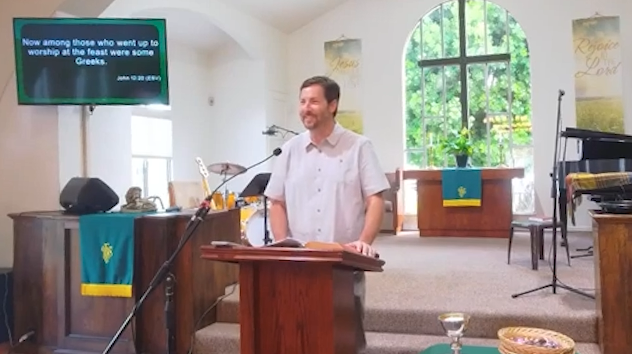
Click the image to watch the message.
Message given at Seaside Church in Torrance, CA on September 13th, 2026:
Brothers and sisters, I hope you've been well since the last hot day we spent together. It has been all hot days since then, it seems. Today I wanted to start with a quote that is attributed to Martin Luther from 1518. He said, when he was disputing with the Catholic Church back then and kind of beginning what we know as the Reformation, "The cross alone is our theology." And I think today, in this particular text, as these Greeks come to meet Jesus, we learn that essentially that's exactly what Jesus is talking about — that the cross alone is our theology. So while we attribute those words to Martin Luther, we ought to attribute that principle and precept, and effectively those words, to Jesus Christ, because he reveals himself here to these Greeks in the final week of his life as the Son of Man who was going to the cross.
So why don't we dive into the text? We'll go verse by verse, as we typically do, and I'll start by praying. Father, thank you for your Word, particularly your Word made flesh in Jesus Christ. Thank you for his welcome of these Greeks at this time, to just declare your will for his life, your will for our redemption, and by way of the cross, your manner of how our sin would be paid for. We thank you for Jesus's sacrifice, and we're so grateful that you brought us into right relationship with you through his sinless life and his substitution for us. And it's in Jesus's name I pray.
All right, well, let's start at verse 20. You know, it's kind of funny. Sometimes you get ideas or thoughts that kind of pop into your head. And I guess there was a Mediterranean festival at a church nearby in Torrance.
Okay, I see the heads are nodding, so it's kind of a popular thing. So that happened yesterday. And the draw is, of course, the food and the culture and everything. We're talking right now about this moment in Scripture as the festival of Passover happening, which, of course, is the great pilgrimage to Jerusalem that the Jews would observe to remember their deliverance from Egypt some — oh, gosh — I think 1,500 years-ish before Jesus was here in this moment. And so I think it's rumored that maybe a million or so, plus two million people, would come to Jerusalem during this time. So the capital that was already Jerusalem, which would normally have a good population, swelled in this week.
And yet the notoriety of Jesus had gotten out at this point in the Gospel to where even Greeks, as it's told to us, were coming to find out more about this guy from Nazareth. So let's look at verse 20: "Now among those who went up to worship at the feast were some Greeks." And now, like I said, this is the last week of Jesus. So we've spent, as Pastor Ben has taught, amongst others like me, through the Gospel of John — we've spent twelve chapters of the Gospel of John getting to this final week, and there are chapters 13 and onward, almost half, or perhaps even more, that are dedicated just to this last week and final days of Christ.
So that shows you how important the Passion Week, Holy Week, the road to the cross really is in the life of Jesus and how he fully ministered and gave his life for our sin. But you might think, okay, well now what's the "previously on," right? Where have we been in the last couple of weeks?
Well, we had at the beginning of chapter 12 Mary, the sister of Martha — what did she do? She took that very expensive jar of fragrance. She broke it, which was, you know, startling. And then she used her hair to anoint the feet of Jesus, which was kind of controversial and more startling. And how was that received by those around them at the time? "What a waste," right? That could have gone to much service for the poor. And what did Jesus say? "The poor you will always have with you, but I will not always be with you." And then moving on, we have the story of Lazarus, and at this point he's no longer dead.
He's living again, right? But even that was a catalyst for more conspiracy. Before this particular part of chapter 12, we realized that just Lazarus being alive again wasn't a miracle that the Jews could accept. It was something to develop another conspiracy around. If we can plot to get Lazarus pictured, then we can do the harm to the ministry and proclamation of Jesus that we intend to do and keep power. And the triumphal entry has happened. I didn't get to teach on that. I would love to have been here with you guys when that was taught. That's a great passage.
But it also plays two ways. It's how Jesus is received as king, but he's received as this earthly king. You know, the gathered worshipers are laying down the palm branches saying, "Hosanna, Hosanna! Blessed is he who comes in the name of the Lord, even the King of Israel," because that's exactly who they thought maybe Jesus was when he was riding into town — the King of Israel.
But Jesus is not just the King of Israel. He's not just in the line of David. He is the Son of God, Son of Man. So he is the King of kings. And so that kind of brings us up to where we are today, where Jesus's fame and his notoriety are colliding. And as much — let's look at how verse 19, before our text today starts — what did the Jews say when Jesus's notoriety and his fame collided? "Look, the world has gone after him."
Well, what does "the world" mean? We've talked about that before. I believe the word is cosmos. And it means the order of everything, the order of this world. So it includes us and how we go about one to another.
But that's how it leads right into verse 20, which said, "Now among those who went up to worship at the feast were some Greeks." Passover was for the Jews. But now the world has gone after him, Jesus. And that includes the world outside of Jerusalem, outside of Judea, outside of Samaria. It actually is now reaching the ends of the earth in some way in terms of Jesus's fame. And that includes these Greeks who have come to meet Jesus.
So again, verse 20: "Now among those who went up to worship at the feast were some Greeks." These Gentiles had caught on. You know, think of the Greeks. They were polytheists, right? They were very carnal. They were used to an empire that was in recession now because it was a Roman empire.
But they were a cultural influence as such. You know, there were Greeks that populated the area around Judea. Specifically, we have the Decapolis, which you guys might know or remember. It is the ten cities that were basically Greek outposts around the Sea of Galilee. And so that's probably where these Greeks come from, down from Galilee, drawn by the notoriety and fame of Jesus. And they want to meet the man. They're setting aside their polytheism, and they're not seeing circumcision as a barrier of entry into this King of Israel, which is really powerful because Jesus had said, "I have come to save the lost house of Israel."
And then Paul would later say, Jesus came to the Jew first and then the Gentiles. So now we start to see this message of the gospel through Jesus Christ not only playing out to the Jews, but also to the Greeks, as we say later in verse 21. So these came to Philip, who was from Bethsaida in Galilee, and asked him, "Sir, we wish to see Jesus."
Why Philip? Just, you know, it's like cast a lot — one of twelve, you'll get one guy who'll give you access. Well, that's not actually the case. Philip is a Greek name. We know it as an English name — Philip, Phil — you could probably make other derivations of that name. You know, we have Philippi, of course, that town which was later where the church was started by Paul.
But Philip is a Greek name meaning "lover of horses." So it's pretty interesting to know that you're known as a lover of horses, and yet somehow Jesus is still humble enough to ride the back of a donkey — you're at the great triumphal entry.
So that's one aspect of why the Greeks would pursue Philip. Did they know Philip? We don't know. But Philip being from Bethsaida — again, this is northern Galilee, and where the Decapolis was, these Greek cities, these Greek towns — there's just a way, like L.A., where certain neighborhoods kind of rub up against each other and we get to be neighbors, even though we have different cultures. Judea was a more multicultural place than we could give it credit for, even as much as the Jews would like to have it be their own, and they'd like to have the Messiah come and liberate them the way Israel, the state of Israel, is today.
Because the map hasn't changed. It's really like this thoroughfare of culture between Africa, Europe, and Asia. And so right in the middle, certainly with God's intention, is the land of Israel, the chosen land where Jesus would come into Jerusalem. So by Bethsaida being in northern Galilee, this is another clue as to why Philip was the sort of point of access for these Greeks. "We want to meet Jesus. How can we meet Jesus?" And then he goes and tells Andrew. Andrew as well is from Bethsaida. So here you have kind of ministry at scale. And what did Jesus do when he sent his apostles out?
Teams of two, right? So it makes perfect sense now that some of this sort of teamwork and ministry — maybe it's becoming the culture of how the gospel goes. When you go talk to one, you talk to another. And I think there's actually — not only is this kind of like a chain of command we could see: okay, they come talk to Philip, now let's go talk to Andrew.
Let's figure this out. And then we get to Jesus. It's like a chain of command was also a chain of partnership. And I think there's a little bit of a point of application here, as you guys do church at Seaside. You have teammates all around you, right? When we have faith in Christ, we should have a shared identity. And so it's not on just your shoulders. To get stuff done involves someone in the work. Because clearly here that's what Philip was doing, I think in a godly way — involving Andrew to say, "Hey, these guys want to meet Jesus. What should we do?" And what do they do?
They go to Jesus, because then Jesus tells us what to do, because he's Jesus. So I think that's an interesting point of application: that as these sort of outsiders, as these non-Jews want to meet the man, the door's open — but the door's open because we have a heart of service.
Okay, well, let's go to verse 23. And Jesus answered them — so he's answering Philip, Andrew, and the Greeks — "The hour has come for the Son of Man to be glorified." And as I said, with the world going after Jesus, evidenced by the Greeks now making this Passover pilgrimage, Jesus is stating this publicly. He's talking about this hour.
Let's deal with the word "glorified" first. What does glorified mean when it hits your ears? Honor being bestowed, a medal being awarded, having your name in lights. And that's kind of the glory. It's funny — another thing that came to mind. I got to go to the USC game last night with my son and my brother-in-law and his dad. They're the ones with tickets. And so when you're invited to games like that, you go, because then you don't have to be the season ticket holder, right? And then interesting things happen. At USC, since I went there twenty-odd years ago for grad school, everybody's name is on something.
They have found a way to monetize almost every square corner of everything, including the Coliseum, which they only have a lease on. And yet everybody's name is on something. That is earthly glorification. And yes, you can exchange a contribution and receive this tunnel being named after you, or the scoreboard being named after you, or having your brick — even that is probably more my budget. I could do that in front of the Coliseum now and have that be named for me. And that's earthly glorification.
But the Son of Man is to be glorified, and the Son of Man is a title that Jesus has used for himself. So he's not talking about earthly glorification. He's mentioned this name of himself earlier on, as early as, I think, the fifty-first verse of John 1, but it refers to something Daniel said in his prophecy. So let me read from Daniel 7:13–14: "And behold, with the clouds of heaven there came one like a son of man, and he came to the Ancient of Days and was presented before him. And to him was given dominion and glory and a kingdom, that all peoples, nations, and languages should serve him.
"His dominion is an everlasting dominion, which shall not pass away, and his kingdom one that shall not be destroyed." So Jesus is now declaring in verse 23, the hour — this time, this moment — has come for the Son of Man to be glorified, and this glory is going to come according to the prophecy of Daniel.
But it's not always as we've seen when we think of our things in our earthly lens. You know, we might think of glorification as "let's cash the check, let's ride the wave, let's live the dream" — my wife and I. And it's funny because the triumphal entry involves the donkey. We were just, you know, having a fun conversation speaking about maybe our sort of earthly glorification will be when the kids are launched. We'll have — we have hound dogs right now. So we have obnoxious pets, and we want a donkey because a donkey is another obnoxious pet. And so in some ways, ours is going to come from maybe a brick at the Coliseum and maybe another obnoxious pet like a donkey.
But again, "glorified" means something to God that we couldn't understand until the grace of God gave us Jesus Christ and the cross. How does Jesus explain this? Because again, the Greeks needed to know it. We need to know it today.
Verse 24: "Truly, truly, I say to you" — this is Jesus speaking — "unless a grain of wheat falls into the earth and dies, it remains alone; but if it dies, it bears much fruit." If not for the sinless Jesus Christ and his willing, selfless death on the cross, sacrifice would just be kind of a trope. It'd be a narrative arc. It would be a device in a story. You guys have indulged in the past talking about movie quotes for a while.
Let's do three from Disney. We have Disney fans in here. Oh yeah. Disney has made a big company out of this kind of trope. Okay, the movie Up, which is Pixar. The first few minutes of the movie involve a love story between a husband and wife, and then the wife dies, like in the first five minutes. Sorry. Spoiler alert, right. Sorry, Bambi. We probably all know Bambi, right? Beautiful little deer — within the first act, mom is lost in a fire. Lion King — circle of life. If not for the king to be caught up in that stampede and die, we wouldn't have the forging of King Simba.
But these are all Disney's take on the triumph of the will. What Jesus is talking about here, when the Son of Man is to be glorified, is a triumph of God's will. And so that's why what he's talking about isn't just a trope. There's a selflessness. There's a sacrificial nature of Jesus going to the cross. There is this proclamation to these Greeks that even for them, outside of the chosen people, this sacrifice has substance, because the power of sin, as we'll see later in the text, is going to be dealt with. And that's what he means when he talks about in this sort of parable of this wheat, the grain of wheat here.
It propagates new life when it dies and falls into the earth. I mean, the first time I got to teach with you guys last year was the parable of the soils, right? And we know in the good soil the seed has a harvest that's thirty- or sixtyfold or a hundredfold. It's about a bumper crop that is the ministry of the church.
But two thousand years later, we have a bumper crop of believers who are called to go make more believers. Let's look at — yeah, let me do verse 24 one more time: "Truly, truly, I say to you, unless a grain of wheat falls into the earth and dies, it remains alone; but if it dies, it bears much fruit." You might have heard the saying that Tertullian wrote: the seed of the church is the blood of the martyrs. And yet Jesus has called himself the cornerstone. And in Matthew 21:42 it was written, "The stone that the builders rejected has become the cornerstone. This was the Lord's doing, and it is marvelous in our eyes."
So we ought to remember that when the Son of Man is to be glorified, this is a marvel to our eyes, because it's not something we could do for ourselves. And this actually — when Jesus said this, he's quoting Psalm 118, and the verse that comes right after that quote in Psalm 118 is a verse that probably all of us know by heart: "This is the day that the Lord has made; let us rejoice and be glad in it." So we can certainly rejoice in this day right now, as the Lord has made it, because the weather is finally temperate and we are all here together, and we have this wonderful shelter, and we have the Holy Spirit present among us, and we are celebrating Jesus, and we're going to do communion.
But because of Christ on the cross — the cross alone being our theology — that's why we actually get to rejoice, because we get to do that for eternity in heaven. And this is God's plan. Verse 25: "Whoever loses his life loses it" — I'm sorry, excuse me — "Whoever loves his life loses it, and whoever hates his life in this world will keep it for eternal life." This is very strange logic for us who want to build bigger storehouses, or who want to wear our Sunday best, or who want to put a presentation to the world that we have it all together. Whoever loves his life loses it — well, that just means when it's over, it's over.
There was a play in high school that I did stage crew for called You Can't Take It With You. It was a comedy, right? Because you can't. You can't take it with you. What you have here, you can't take it with you.
But what you have in here, you can. This little light of mine. And John, the writer of this Gospel — he kind of hammers this point home. I love when the Bible gives its own interpretation and application and argument in one bit.
But when we're talking about how you don't want to love what you have here in the world so much that it will distract you from God's will for your life, let's look at what 1 John 2:15–17 tells us: "Do not love the world or the things in the world. If anyone loves the world, the love of the Father is not in him. For all that is in the world — the desires of the flesh and the desires of the eyes and pride of life — is not from the Father but is from the world. And the world is passing away along with its desires.
"But whoever does the will of God abides forever." Now the apostle John wrote this decades after this moment in the Gospel, but I'd love to think that he had the presence to know of following Jesus being so important as to tell the Greeks, in a little sidebar in this moment: hey, you guys love your many gods, but they're demigods and they push power down. We have — deity added — I'm sorry — humanity added to deity in the person of Jesus. He came down from heaven to serve us. It's a whole flip of the world's outlook, just as it is today.
So Jesus gives explanation in verse 26: "If anyone serves me, he must follow me; and where I am, there will my servant be also. If anyone serves me, the Father will honor him." I've mentioned in the past that my favorite Dietrich Bonhoeffer quote is "Only he who believes is obedient, and only he who is obedient believes," right? The following of Jesus is a command to be obedient.
But then Jesus says, my commands are not burdensome. It's just love God with all your heart, soul, mind, and strength, and love your neighbor as yourself. And in the doing of that we realize, oh, we can't do that without the grace of God which is given to us, and we don't do it under our own strength. We do it by his strength because he has done what he's about to do.
Let's go to the cross for our sin. So here we are in verse 27: "Now is my soul troubled. And what shall I say? 'Father, save me from this hour'? But for this purpose I have come to this hour." And I think again, we're in this audience of the Greeks amongst the disciples. Jesus is carrying a burden to the cross, yet he goes willingly. He's more than a martyr. The martyr is the seed of the church.
But Jesus is the cornerstone of the church. Is he going out of fear? No. Jesus wasn't afraid to go to the cross. Is he going out of doubt or denial, or any of the things that would happen amongst the disciples in the next coming chapters? No, his soul is troubled because the weight of sin is that great. Our condition in sin is that much of a separation from our God, whose image we bear and where he is in heaven, and how far away that is, and how hard it is to get there, and how impossible it is to get there under our own devices. Jesus knows the full weight of the sin, which should tell us as believers what he was carrying that troubled his soul.
It was a heavy weight to bear — more than we can qualify, more than we can calculate. Yet he went willingly. I kind of think that Jesus in his mind, because he was so good — the author of Scripture — that he could quote Scripture whenever he needed to as God was revealing himself through Jesus to us.
Let's think of Psalm 23:4: "Even though I walk through the valley of the shadow of death, I will fear no evil, for you are with me; your rod and your staff, they comfort me." Jesus tells the Greeks, he tells the disciples: "But for this purpose I have come to this hour." So in verse 28 of our text today: "Father, glorify your name." Jesus is saying here, not my will be done, but your will be done. And he taught us this when he told the disciples how they should pray. And we get to say that — we'll say it again today — but let's read it now.
The wonderful Lord's Prayer. Jesus in Matthew 6 said, "Pray then like this: Our Father in heaven, hallowed be your name. Your kingdom come, your will be done, on earth as it is in heaven. Give us this day our daily bread, and forgive us our debts, as we also have forgiven our debtors. And lead us not into temptation, but deliver us from evil. For if you forgive others their trespasses, your heavenly Father will also forgive you.
"But if you do not forgive others their trespasses, neither will your Father forgive your trespasses." That's a pretty difficult task if we think about it in our own mind and effort. Forgiveness is hard to do, but Jesus will later say at the cross — several chapters from now, but only days from now in time — "Father, forgive them, for they know not what they do." So when we look to the model of forgiveness, we look to the soul that bears trouble, that still goes to the cross and forgives as he is the substitute for our sin, and becomes that exchange of righteousness that we then get by.
Nothing we can do, but all that we receive. And in this way we can take heart that forgiveness comes when we know that we have forgiven. First: "Father, forgive them, for they know not what they do." And so verse 28, picking up verse 28 in our text today: then a voice came from heaven — "I have glorified it" — this is the name — "and I will glorify it again." So there are a couple of times in the Gospel of John where the voice from heaven cries out, and it's the Father talking. And for those who have ears to hear, let them hear. For those who have eyes to see and read this text, it's our Father in heaven voicing out his affirmation of his Son on earth.
We have that in Matthew 3:17: "This is my beloved Son, with whom I am well pleased." That was when Jesus was baptized. We have it again at the Transfiguration, Matthew 17: "And behold, there appeared to them Moses and Elijah, talking with them. And Peter said to Jesus, 'Lord, it is good that we are here. If you wish, I will make three tents here, one for you and one for Moses and one for Elijah.' He was still speaking when, behold, a bright cloud overshadowed them, and a voice from the cloud said, 'This is my beloved Son, with whom I am well pleased; listen to him.'" Here again this voice from heaven is saying, "I have glorified it."
Those are two instances — and "I will glorify it again" at the cross, because the cross alone is our theology. There's a little standard. So I've been in video production in business for almost thirty years now, and I've gotten to the point where you've got to be efficient, so you write your own contracts. Obviously, I do research for contracts. There's this term called "avoidance of doubt." For avoidance of doubt: you know, client agrees to and vendor agrees to, blah, blah, blah. I think this is kind of the Father in heaven being so gracious to us by his Word and saying, "I have glorified it" — the name of my Son — "and I will glorify it again."
For avoidance of doubt, I am sending my Son, who is going willingly to the cross for my image-bearers so that we can be redeemed. But the crowd — this is a great crowd — and in verse 29 they say: the crowd that stood there heard it. So they heard the voice and said that it had thundered. Well, we heard some thunder, I think last week with the storms that came through, and the first crack of thunder never sounds like a word to me. Although it is God ringing out in creation, it sounds like something I want to be sheltered from. So I can understand the reception of the Greeks — the awe and fear of this voice — and also understand that there was a point in time where I couldn't discern the Word of God.
You know, I hadn't been drawn in yet by the Father, but by his grace he did. And so that's what they're hearing. Others said an angel has spoken to him. But the Gospel writer tells us that this is the Father speaking from heaven. And how do we know? Jesus tells us in verse 30. Jesus answered, "This voice has come for your sake, not mine."
Now why would you say that? Because everything the Father has done, including sending his Son from heaven, having him stoop to our condition in humanity, having him approach the cross, having him go through all that he's about to go through the next several days — it's for our sake. It's so that we may be in relationship with the Father in heaven. Jesus knows this. He knows all these facts. He knows all the story. He knows the arc. He knows that he's not a plot device in a Disney movie. In fact, he continues, verse 31: "Now is the judgment of this world.
"Now will the ruler of this world be cast out." At long last, in a couple of days' time, the head of the serpent will be crushed. Jesus on the cross will say, "It is finished." What is he describing when it is finished? The power of sin no longer holds power over us. Jesus's righteousness on the cross and the exchange of his life and his taking all of our sin upon him in death — the ruler of this world, the prince of the power of the air, as we talked about in Ephesians 6, the devil — he will be cast out. He will no longer have, for those who believe in Jesus, power over us to deceive us. We will still live in our flesh.
We'll be in the presence of sin in this world that we're told is passing away. But Jesus is saying the quiet part out loud: now is the judgment of this world; now will the ruler be cast out. And verse 32: "And I, when I am lifted up from the earth, will draw all people to myself." And so we're approaching the end of our text today, and this is one of the most fascinating revelations that Jesus does, looking back to the whole story of God's revelation to his people. So "lifted up" — we could probably discern "lifted up" means he's going to go up on the cross, right? Like I've been hammering home: the cross alone is our theology.
As archaeology, we know what crucifixion is — represented right there behind me, and our icon of how the Romans devised this incredibly excruciating way to terminate life. But back in Numbers 21:4–9, the Israelites were rebellious against God's deliverance plan for them. They wanted to go back. They wanted to complain. They wanted to curse God for the situation they found themselves in. And so God commanded fiery serpents to torment the people. And they were biting, and they were snapping, and they were causing physical harm. And then he commanded Moses to fashion a bronze serpent and put it on a pole. And when that was lifted up, and their eyes looked upon that pole, they would be healed.
So there you have this Christ-type, this image of God's grace and salvation for the Jews, being echoed by Jesus saying, when I am lifted up — the cross wasn't an accident. It wasn't just, well, the best means of torture and death available at this particular time. It was significant all the way through how God had been working with his people in his plan to redeem them all along. And I think that's fascinating to look back, especially as in John 3:16, which we all know: "For God so loved the world, that he gave his only Son, that whoever believes in him should not perish but have eternal life." Right before that, in John 3:14–15 it reads: "And as Moses lifted up the serpent in the wilderness, so must the Son of Man be lifted up, that whoever believes in him may have eternal life."
So it all comes back together. This glory of being lifted up on the cross is essentially the theology that goes back into the Old Testament. So verse 33: he said this to show by what kind of death he was going to die. Yeah — the cross. Before that he'd be betrayed, denied, abandoned, tried, beaten, scourged, made to be his own mover, carry his own cross until they got a little bit of help. And then he'd be stripped and he'd be pierced and be lifted up. And that's troubling to the soul, we think.
But that's not what troubled Jesus's soul. Remember, the troubled soul was: there is so much sin to be paid for. And yet I'm willing. What a good, wonderful Savior. So to conclude our text today, verse 34. So the crowd answered him again — the crowd, the Greeks. The Greeks had come wanting to meet Jesus. They wanted to get an autograph.
Well, let's say they wanted more than an autograph if they wanted to meet him. They say, "We have heard from the Law that the Christ remains forever. How can you say that the Son of Man must be lifted up? Who is this Son of Man?" That Jesus is — and it wasn't in our text today, but Jesus speaks in parable right away. So this will be our final application point, because I think we can take this verse with us as we go.
Well, maybe I'll repeat it again in the benediction, but verse 35 continues. So Jesus said to them, "The light is among you for a little while longer. Walk while you have the light, lest darkness overtake you. The one who walks in the darkness does not know where he is going. While you have the light, believe in the light, that you may become sons of light." So the Son of Man is the Son of God. And while we have breath in our lungs, we can understand who the light of men was. It was Jesus Christ. And for these Greeks — Tuesday of Passion Week, maybe Wednesday; I'm not really sure what the exact day was — but only days from the cross, days from when the whole price would be paid.
On the cross. We end up with Jesus revealing himself as the Son of Man, saying to them: put aside your distractions of polytheism. While you have the light, believe in the light, that you may become sons of light.